
The BHEL Artisan syllabus lists topics for seven trades: Electrician, Electronics Mechanic, Fitter, Foundryman, Machinist, Turner and Welder. Bharat Heavy Electricals Limited (BHEL) published it as the PDF “BHEL Artisan – CBE Syllabus” on careers.bhel.in. Every trade carries 70 marks for theory and 30 marks for Engineering Drawing and Workshop Calculation.
This page gives every topic for all seven trades as plain text, the marks split and the Test of Reasoning topics. New notices from BHEL and other bodies appear in our latest All India jobs section. Candidates should check all details in the article below.
Information verified from the official BHEL syllabus PDF “BHEL Artisan – CBE Syllabus” on careers.bhel.in.
Last verified: 24 October 2026.
The BHEL Artisan syllabus gives each of the 7 trades a theory part of 70 marks and an Engineering Drawing and Workshop Calculation part of 30 marks. A separate Test of Reasoning carries 20 marks. The full topic-wise list for every trade is given below.
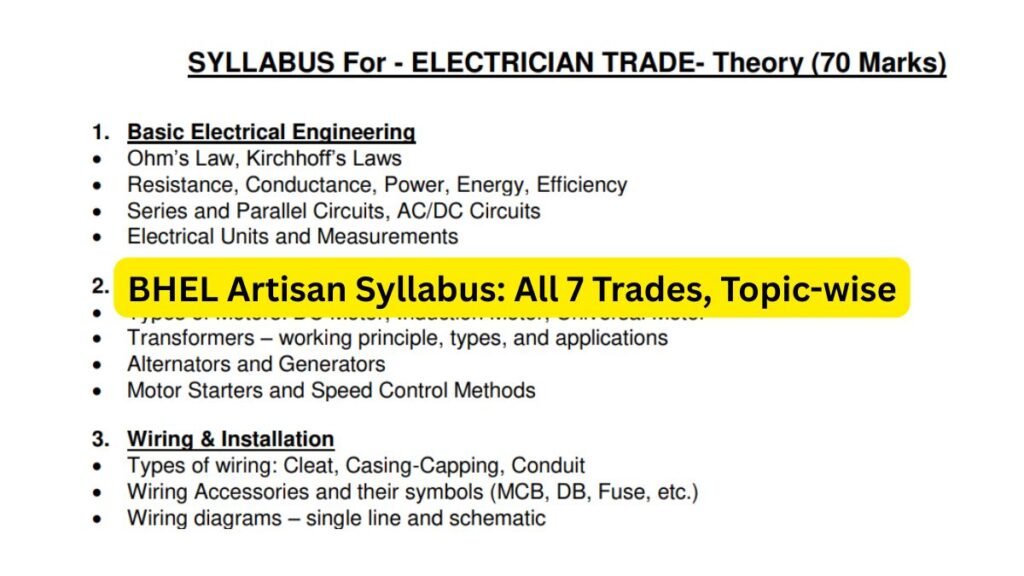
Quick Summary of BHEL Artisan Syllabus
| Item | Detail |
|---|---|
| Organisation | Bharat Heavy Electricals Limited (BHEL) |
| Exam | BHEL Artisan Computer-Based Examination (CBE) |
| Trades | 7 |
| Trade theory | 70 marks |
| Drawing and calculation | 30 marks |
| Test of Reasoning | 20 marks |
| Official website | careers.bhel.in |
BHEL Artisan exam pattern
The BHEL Artisan syllabus PDF splits marks across three parts.
| Part | Marks | Topic list |
|---|---|---|
| Trade Theory | 70 | One list per trade |
| Drawing and Calculation | 30 | One list per trade |
| Test of Reasoning | 20 | One list |
Each trade section of the BHEL Artisan syllabus below carries its own theory list and its own Engineering Drawing and Workshop Calculation list. The Test of Reasoning list follows after the Welder trade.
Also Read: ISRO URSC Recruitment 2026 – 10th Pass ITI & Driver Jobs
BHEL Artisan syllabus for Electrician trade
Electrician theory (70 marks)
The theory part of the BHEL Artisan syllabus for this trade has 10 topic groups.
1. Basic Electrical Engineering
- Ohm’s Law, Kirchhoff’s Laws
- Resistance, Conductance, Power, Energy, Efficiency
- Series and Parallel Circuits, AC/DC Circuits
- Electrical Units and Measurements
2. Electrical Machines
- Types of Motors: DC Motor, Induction Motor, Universal Motor
- Transformers: working principle, types, and applications
- Alternators and Generators
- Motor Starters and Speed Control Methods
3. Wiring & Installation
- Types of wiring: Cleat, Casing-Capping, Conduit
- Wiring Accessories and their symbols (MCB, DB, Fuse, etc.)
- Wiring diagrams: single line and schematic
- Fault finding in domestic and industrial wiring
- Earthing techniques
4. Tools, Safety & Maintenance
- Hand tools and their uses
- PPE (Personal Protective Equipment)
- Electrical Safety Practices (shock prevention, fire hazards)
- Preventive and breakdown maintenance
5. Electrical Drawing & Reading
- Reading and interpreting circuit diagrams and schematics
- Panel wiring diagrams
- Symbols used in electrical drawings
6. Measuring Instruments
- Multimeter / Digital Multimeter, Megger, Voltmeter, Ammeter, Wattmeter
- Energy Meter
- Clamp Meter: usage and precautions
7. Earthing and Grounding
- Purpose and methods of earthing
- Types of earthing (Pipe, Plate, Rod)
- Earth resistance: permissible values and testing
8. Fundamentals of Electronics
- Diodes, Rectifiers, LEDs
- Transistors (basic function)
- Relays and Contactors
9. Batteries and UPS
- Battery types, charging methods, and safety
- Inverter and UPS: working and applications
10. Industrial Electricals
- Basics of PLC, control panels
- Electrical motors used in industry (HT/LT)
- Electrical machines manufactured by BHEL
Electrician drawing and calculation (30 marks)
The drawing part of the BHEL Artisan syllabus for Electrician lists drawing topics first, then workshop calculation.
Engineering Drawing
- Reading of Electrical Sign and Symbols
- Reading of Electrical Circuit Diagram & Reading of Electrical Layout drawing
- Sketches of Electrical components
- Reading of Electrical wiring diagram and Layout diagram
- Reading of Electrical earthing diagram
- Drawing the schematic diagram of plate and pipe earthing
- Drawing of Electrical circuit diagram
- Drawing of block diagrams of Instruments & equipment of trades
Workshop Calculation
- Unit, Fractions
- Square root, Ratio and Proportions, Percentage
- Algebra: Addition, subtraction, multiplication & division, Theory of indices, algebraic formula
- Mensuration: Area and perimeter of square, rectangle and parallelogram, Area and perimeter of Triangles
- Profit and loss: Simple problems on profit & loss, Simple and compound interest
- Estimation and Costing
- Material Science: Types of metals, types of ferrous and non-ferrous metals
- Heat & Temperature and Pressure: Concept of heat and temperature, effects of heat, difference between heat and temperature, boiling point & melting point of different metals and non-metals
- Elasticity: Elastic, plastic materials, stress, strain and their units and young’s modulus
BHEL Artisan syllabus for Electronics Mechanic trade
Electronics Mechanic theory (70 marks)
The Electronics Mechanic list in the BHEL Artisan syllabus has 38 topics, from hand tools to LCD and LED TV.
- Hand tools and their uses: Identify tools; filing, hacksawing, fitting, drilling, and basic metalwork.
- Basics of AC and Electrical Cables: Identify, test, measure, and prepare electrical cables; basic electrical concepts and cable specs.
- Single-range meters: Set meters; check continuity; measure voltage and current.
- Cells & Batteries: Identify terminals, measure voltage, charge/discharge, test readiness, types and specifications.
- AC & DC measurements: Use multimeter, CRO/DSO, and function generator to measure and observe electrical parameters; learn meter types, controls, and maintenance.
- Digital Storage Oscilloscope: Identify controls, measure signal parameters, print signals, and build/test a function generator; learn features and applications of DSO and CRO.
- Soldering/ De-soldering and Various Switches: Practice soldering/de-soldering, repair PCB tracks, identify and use various switches, and make switch panel boards.
- Active and Passive Components: Identify and test resistors, inductors, capacitors, relays, and circuit breakers; Ohm’s and Kirchhoff’s laws; RC circuits and resonance circuits.
- Power Supply Circuits: Test diodes and transformers; build and test rectifiers; measure ripple; voltage regulators; transformer types and diode basics.
- IC Regulators: Test diodes and transformers, build and test rectifiers and voltage regulators, measure ripple and regulation. Construct fixed and variable IC-based voltage regulators (78/79 series, LM317T, IC723). Diode biasing, transformer types, rectifier efficiency, and regulator principles.
- Transistor: Identify and test transistors, understand construction and terminals, learn biasing, characteristics, and applications as switches and amplifiers.
- Amplifier: Build and test various transistor amplifiers (fixed, emitter, voltage divider bias, common emitter, collector, biasing, configurations, characteristics, gain, and feedback.
- Oscillators: Build and test Colpitts, Hartley, RC phase shift, and crystal oscillators; demonstrate astable, monostable, and bistable multivibrators; understand positive feedback.
- Wave shaping circuits: Build and test shunt, series, dual clippers, clampers, and Zener diode peak clippers.
- Power Electronic Components: Identify power components; build and test FET amplifiers, SCR circuits, TRIAC dimmers, and UJT oscillators; terminals, and applications.
- MOSFET & IGBT: Identify and test MOSFETs and IGBTs, characteristics, switching speed, and differences from FETs and transistors.
- Opto Electronics: Test LEDs, circuits with photovoltaic cells, photodiodes, and phototransistors; characteristics and applications of optical sensors and opto-isolators.
- Basic Gates: truth tables of logic gates; build gates using NAND/NOR; test digital ICs; learn digital basics and number systems.
- Combinational Circuits: Build and test adders, subtractors, decoders, encoders, multiplexers, and demultiplexers.
- Flip Flops: Identify and test various flip-flop ICs (RS, D, T, JK), latches, and understand timing and applications.
- Op-Amp & Timer 555 Applications: Test analogue ICs, Op-Amp circuits (amplifiers, integrators, comparators), and construct timer 555 circuits (astable, monostable, VCO, PWM).
- Electronic Cables & Connectors: Types of cables/connectors, soldering, testing, and PC/network cable setups.
- Basic SMD (2, 3, 4-terminal components): Identify, de-solder, and solder 2, 3, 4 terminal SMD parts; check PCB continuity; find loose solder and broken tracks. Learn SMD advantages, reflow soldering, hardware selection, and inspection.
- SMD Soldering and Desoldering: Set up an SMD soldering station, use crimping tools for various IC packages, solder/de-solder ICs, rework defective components, inspect solder quality, and understand SMT equipment like pick-and-place machines and reflow ovens.
- PCB Rework: Inspect, test, and repair single- and double-layer PCBs. Detect solder joint defects, fix damaged tracks, pads, and solder masks. Learn ESD prevention and non-soldering interconnections.
- Protection devices: Identify types of fuses, holders, MCBs, ELCBs, contactors, and relays; understand fuse ratings and working voltages. Test MCBs, ELCBs, DC motors, and stepper motors; understand motor control and protection devices.
- Communication electronics: Practice AM/FM modulation and demodulation, test transmitters/receivers, study antennas, modulation types, and digital signal techniques.
- Microcontroller (8051): Identify ICs, configure ports, blink LEDs, use timers, write simple programs. Learn architecture, memory, registers, and compare 8051/8052. Intro to PIC.
- Sensors, Transducers used in IoT Applications: Identify and use sensors (temperature, proximity, load cells). Measure and detect signals. Basics of transducers. Connect and program a microcontroller (LED, buzzer, sensors). Introduction to IoT and smart systems.
- Analogue IC Applications: Build simple projects using ICs 741, 723, 555, 7106, 7107. Examples: laptop protector, battery monitor, metal detector, smoke detector, water level controller, etc. Focus on component use and IC data. (45 Hrs practical + 9 Hrs discussion)
- Digital IC Applications
- Fibre optic communication
- Digital panel Meter: Use LED/LCDs with driver ICs to show text and measure current. Learn seven-segment displays, multiplexing, and DPM ICs.
- SMPS and Inverter: Identify, dismantle, test, troubleshoot, repair, and install SMPS and inverters. Build/test DC-DC converters. Learn working principles.
- UPS: Connect and test battery and load; identify UPS components and circuits; monitor voltages; perform backup load test. UPS types, principles, specs, installation, and protections.
- Solar Power (Renewable Energy System): Wire solar controller, connect batteries & inverter, test solar panel with load, install solar inverter, measure charging time. Learn solar energy principles, PV cells, modules, systems, controllers, and safety.
- LED Lights: Identify and connect LED stacks and circuits. Series/parallel LED strings and matrix. Test voltages. LED panel types and driving.
- LCD and LED TV: Identify, dismantle, troubleshoot, repair, and test TVs and remotes. Connect external devices. Learn basics of TV types, interfaces, and remotes.
Electronics Mechanic drawing and calculation (30 marks)
The BHEL Artisan syllabus pairs electronics symbols and circuit diagrams with workshop calculations for this trade.
Engineering Drawing
- Engineering Drawing and Drawing Instruments: Conventions, Sizes and layout of drawing sheets, Title Block, its position and content, drawing instruments
- Freehand drawing of: Geometrical figures and blocks with dimensions, transferring measurements from the given object to the freehand sketches, freehand drawing of hand tools and measuring tools
- Lines: Types and applications in drawing
- Geometrical figures: Angle, Triangle, Circle, Rectangle, Square, Parallelogram. Lettering & Numbering: Single Stroke, double stroke, inclined
- Electronic Circuit Diagram, Electronic Layout Drawing
- Electronic signs and Symbols, electronic components, block diagrams of Instruments & equipment of trades
Workshop Calculation
- Unit, Fractions
- Square root, Ratio and Proportions, Percentage
- Algebra: Addition, subtraction, multiplication & division, Theory of indices, algebraic formula
- Estimation and Costing
- Material Science: Types of metals, types of ferrous and non-ferrous metals
- Heat & Temperature and Pressure: Concept of heat and temperature, effects of heat, difference between heat and temperature, boiling point & melting point of different metals and non-metals
- Trigonometry
BHEL Artisan syllabus for Fitter trade
Fitter theory (70 marks)
The Fitter theory part of the BHEL Artisan syllabus has 31 topics, from marking tools to gauges and selective assembly.
- Marking off and layout tools, dividers, scribing block: description, classification, material, care & maintenance.
- Try square, ordinary depth gauge, protractor: description, uses and care.
- Uses, care & maintenance of cold chisels: materials, types, cutting angles.
- Power Saw, band saw, Circular saw machines used for metal cutting.
- Micrometre, outside and inside: principle, features, parts, graduation, reading, use and care. Micrometre depth gauge: parts, graduation, reading, use and care. Digital micrometre.
- Vernier callipers: principle, construction, graduations, reading, use and care. Vernier bevel protractor: construction, graduations, reading, use and care. Dial Vernier Calliper, Digital Vernier calliper. Vernier height gauge: material, construction, parts, graduations (English & Metric), uses, care and maintenance.
- Drilling processes: common types (bench type, pillar type, radial type), gang and multiple drilling machines, Determination of tap drill size.
- Marking and measuring tools, wing compass, Tinman’s square tools, snips, types and uses, Tinman’s hammers and mallets, sheet metal tools, types, specifications, uses.
- Trammel: description, parts, uses.
- Hand grooves: specifications and uses.
- Sheet and wire gauge.
- Precautions in electric and gas welding. (Before, during, after), safety equipment and their uses.
- Machines and accessories, welding transformer, welding generators, Welding hand tools: Hammers, welding description, types and uses, description, principle, method of operating, carbon dioxide welding.
- H.P. welding equipment: description, principle, method of operating, L.P. welding equipment: description, principle, method of operating.
- Types of Joints: Butt and fillet as per BIS SP:46-1988 specifications. Gases and gas cylinder description, kinds, main difference and uses.
- Setting up parameters for ARC welding machines: selection of Welding electrodes.
- Oxygen acetylene cutting: machine description, parts, uses, method of handling cutting torch, description, parts, function and uses.
- Drill: material, types, (Taper shank, straight shank) parts and sizes, Drill angle-cutting angle for different materials, cutting speed feed, R.P.M. for different materials, Drill holding devices: material, construction and their uses, Drill troubles: causes and remedy. Drill kinds: Fraction, metric, letters and numbers, grinding of drill.
- Counter sink, counter bore and spot facing: tools and nomenclature.
- Reamer: material, types (Hand and machine reamer), kinds, parts and their uses, Determining hole size (or reaming), Reaming procedure.
- Screw threads: terminology, parts, types and their use, Screw pitch gauge: material, parts and uses.
- Taps British standard (B.S.W., B.S.F., B.A. & B.S.P.) and metric /BIS (coarse and fine) material, Parts (shank body, flute, cutting edge).
- Equality of lips, correct clearance, dead centre, length of lips.
- Grinding wheel: Abrasive, grade structures, bond, specification, use, mounting and dressing, Selection of grinding wheels. Bench grinder parts and use.
- Interchange ability: Necessity in Engg, field definition, BIS Definition, types of limit, terminology of limits and fits: basic size, actual size, deviation, high and low limit, zero line, tolerance zone, Different standard systems of fits and limits. British standard system, BIS system.
- Maintenance: Total productive maintenance, Autonomous maintenance, Routine maintenance, Maintenance schedule, Retrieval of data from machine manuals, Preventive maintenance: objective and function of Preventive maintenance, Section inspection, Visual and detailed, lubrication survey, system of symbol and colour coding, Revision, simple estimation of materials, use of handbooks and reference table, Possible causes for assembly failures and remedies, Installation, maintenance and overhaul of machinery and engineering equipment.
- Templates and Radius/fillet gauge, feeler gauge, hole gauge, and their uses, care and maintenance.
- Metallurgical and metal working processes such as Heat treatment.
- Various heat treatment methods: normalizing, annealing, hardening and tempering, purpose of each method, tempering colour chart.
- Annealing and normalizing, Case hardening and carburising and its methods, process of carburising (solid, liquid and gas).
- Gauges and types of gauge commonly used in gauging finished product, Method of selective assembly, ‘Go’ system of gauges, hole plug basis of standardization.
Fitter drawing and calculation (30 marks)
The Fitter drawing part of the BHEL Artisan syllabus includes mensuration, levers and simple machines, and heat treatment.
Also Read: GRID-INDIA Internship 2026 — 15 Seats, Stipend ₹50,000
Engineering Drawing
- Engineering Drawing and Drawing Instruments: Conventions, Sizes and layout of drawing sheets, Title Block, its position and content, Drawing Instrument
- Free hand drawing of: Geometrical figures and blocks with dimension, transferring measurement from the given object to the free hand sketches, Free hand drawing of hand tools and measuring tools
- Lines: Types and applications in drawing
- Geometrical figures: Angle, Triangle, Circle, Rectangle, Square, Parallelogram. Lettering & Numbering: Single Stroke, double stroke, inclined
- Reading of dimension and Dimensioning Practice: Types of arrowhead, Leader line with text, Position of dimensioning (Unidirectional, Aligned)
- Concept of axes plane and quadrant, Concept of Orthographic and Isometric projections, Method of first angle and third angle projections
- Symbolic representation: different symbols used in the related trades
Workshop Calculation
- Unit, Fractions
- Square root, Ratio and Proportions, Percentage
- Algebra: Addition, subtraction, multiplication & division, Theory of indices, algebraic formula
- Mensuration: Area and perimeter of square, rectangle and parallelogram, Area and perimeter of Triangles, Area and perimeter of circle, semi-circle, circular ring, sector of circle, hexagon and ellipse, Surface area and volume of solids: cube, cuboid, cylinder, sphere and hollow cylinder, Finding the lateral surface area, total surface area and capacity in litres of hexagonal, conical and cylindrical shaped vessels
- Levers and Simple machines: Simple machines: Effort and load, mechanical advantage, velocity ratio, efficiency of machine, relationship between efficiency, velocity ratio and mechanical advantage
- Trigonometry: Measurement of angles, Trigonometrical ratios, Trigonometrical tables
- Centre of gravity: Centre of gravity and its practical application
- Area of cut out regular surfaces and area of irregular surfaces: Area of cut out regular surfaces: circle, segment and sector of circle, Related problems of area of cut out regular surfaces: circle, segment and sector of circle, Area of irregular surfaces and application related to shop problems
- Elasticity: Elastic, plastic materials, stress, strain and their units and young’s modulus, Elasticity: Ultimate stress and working stress
- Heat treatment and advantages: Different heat treatment process: Hardening, tempering, annealing, normalising and case hardening
- Estimation and Costing: Simple estimation of the requirement of material etc., as applicable to the trade, Problems on estimation and costing
BHEL Artisan syllabus for Foundryman trade
Foundryman theory (70 marks)
The Foundryman theory part in the BHEL Artisan syllabus has 13 topic groups with numbered sub-topics.
1. Introduction to Foundry
- 1.1 Principles of Foundry, Types of Foundry, Advantages of metal castings, Quality Assurance, Importance of Quality in Foundry
2. Gating System
- 2.1 Elements of Gating system, Types of Gating system, Functions of Gating system, Risers and type of risers, Feeder’s Fluxes, Chills and type of Chills, Directional Solidification, Exothermic Materials (Feeder aids) etc.
3. Sand Testing and Casting Process
- 3.1 Different type of Sand and its Characteristics testing; e.g. Moisture Content Test, Permeability test etc.
- 3.2 Casting Process; e.g. Pressure die casting, Resin Bonded Sand mould Casting etc.
- 3.3 CO2 (Carbon Dioxide) Moulding
- 3.4 Mould Coating, Process of coatings and its Type etc.
- 3.5 Removal of Cores, Cleaning and Inspection of Casting
4. Mould and Moulding Process
- 4.1 Type of Moulds: e.g. Green Sand Mould, Dry Sand Mould etc.
- 4.2 Parts of Mould; e.g. Pouring Basin, Ingate, Cope etc.
- 4.3 Hand Moulding and Its Type (Moulding Process)
- 4.3.1 Bench Moulding
- 4.3.2 Floor Moulding
- 4.4 Machine Moulding
- 4.4.1 Hand Operated Moulding Machine
- 4.4.2 Power Operated Moulding Machine
5. Moulding Sand
- 5.1 Properties of Sand: e.g. Porosity or Permeability, Collapsibility etc.
- 5.2 Principal Ingredients of Moulding sand
- 5.2.1 Sand: Types of sand, Shape of sand and other ingredients
- 5.3 Classification of Sand: Green Sand, Core sand etc.
- 5.4 Characteristics of sand
- 5.4.1 Composition, AFS (American Foundry Society) Fineness No, Strength etc.
- 5.5 Preparation of Sand: Grinding Sieving etc.
6. Foundry Tools
- 6.1 Types of Tools: Marking, Measuring, etc.
7. Pattern
- Types of Pattern etc.
8. Furnaces
- Type of Furnaces for Melting and Secondary Refining: e.g. Induction Furnace, VAD etc.
9. Melting Charge Calculation For Cast Iron and Steel
10. Non-Ferrous Metals
11. Fundamentals and Type of Heat Treatment Furnaces
- e.g. Normalizing, Tempering etc.
12. Iron-Carbon Equilibrium Diagram for carbon Steel and microstructure of Phases
13. Occupational Safety and Health
- e.g. Causes of Accidents, Cause of Fire, Personal Protective Equipment (PPE) for different operations etc.
Foundryman drawing and calculation (30 marks)
This part of the BHEL Artisan syllabus lists eight calculation topics and eight drawing topics.
Workshop Calculations
- Units, Fractions
- Square root, Ratio and Proportions, Percentage
- Material Science
- Mass, Weight, Volume and Density
- Work, Power and Energy
- Mensuration
- Levers and Simple Machines
- Trigonometry
Engineering Drawing
- Drawing Conventions, Sizes and Scales of a drawing
- Drawings Instruments (2D & 3D Tools)
- Projection Systems (Orthographic & Isometric views), Sectional Views and Assembly Views
- Various types of Lines and Free hand drawing
- Drawing of Geometrical Figures
- Dimensioning (Position, Sizing etc.), Concepts of dimensional Tolerances
- Concept and Reading of an Engineering Drawing
- Symbolic Representation (Surface Roughness, Cylindricity, Concentricity etc.)
BHEL Artisan syllabus for Machinist trade
Machinist theory (70 marks)
The Machinist list in the BHEL Artisan syllabus has 24 topics, from drills and taps to cams and worm wheels.
- Drill, Tap, Die-types & application. Determination of tap drill size. Basic terminology related to screw thread. Reamer: material, types (Hand and machine reamer), parts and their uses, determining hole size for reaming, Reaming procedure.
- Vernier height gauge: construction, graduations, Vernier setting & reading. Care and maintenance of Vernier height Gauge. Vernier calliper: its parts, principle, reading, uses & care. Outside micrometre: its parts, principle, reading, uses, Reading of Vernier Micrometre, care & maintenance.
- Drilling machines: types & their application, construction of Pillar & Radial drilling machine. Countersunk, counter bore and spot facing: tools and nomenclature. Cutting Speed, feed, depth of cut and Drilling time calculations.
- Interchangeability: Necessity in Engg., field, Limit: Definition, types, terminology of limits and fits: basic size, actual size, deviation, high and low limit, zero-line, tolerance zone, allowances. Different standard systems of fits and limits. (British standard system & BIS system)
- Slotter: Classification, principle, construction, Safety precaution. Introduction and their indexing process on a Slotter by its Rotary table graduations. Driving mechanisms, quick return motion and speed ratio. Safety points to be observed while working on a Slotter. Job holding devices: vice, clamps, V-block, parallel block etc. Slotting tools: types, tool angles. Spline: types and uses.
- Coolant & lubricant: Introduction, types, properties, application & applying methods.
- Milling Machine: Introduction, types, parts, construction and specification. Driving and feed mechanism of Milling Machine. Different types of milling cutters & their use. Cutter nomenclature. Different milling operations: plain, face, angular, form, slot, gang and straddle milling etc. Up and down milling. Different types of milling attachments and their uses.
- Jigs and Fixtures: Introduction, principle, types, use, advantages & disadvantages. Properties of metals general idea of physical, mechanical properties of metals, colour, weight, hardness toughness, malleability, ductility their effect on machinability.
- Heat Treatment: Introduction, necessity, types, Purposes, different methods of Heat Treatment. Heat Treatment of Plain Carbon Steel. Indexing: introduction & types. Indexing head: types & constructional details, function of indexing plates and the sector arms. Calculation for direct and simple indexing.
- Grinding: Introduction, grinding wheel: abrasive, types, bond, grade, grid, structure, standard marking system of grinding wheel, selection of the grinding wheel. Dressing, types of dresser. Glazing and Loading of wheels: its causes and remedies. Roughness values and their symbols.
- Surface Grinder: Types, Parts, construction, use, methods of surface grinding.
- Cylindrical grinder: Introduction, parts, construction, types, specification, safety, different methods of cylindrical grinding. Cutting speed, feed, depth of cut, machining time calculation. Wet grinding and dry grinding, various types of grinding wheels and their application, grinding defects and remedies.
- Tool & cutter grinder: Introduction, parts, construction, use and specification, different types of tool rest & their application. Various methods of cutter grinding. Various cutter grinding attachments and their uses.
- Geometrical tolerances, definition, symbol and their application. Depth Micrometer: Parts, reading, uses and safety. Different types of micrometers and their uses. Inside Micrometer: its parts, reading and uses. Bore Dial Gauge: its parts, reading and uses. Telescopic gauge. Gauges: different types and their uses, difference between Gauges and Measuring Instruments. Gear introduction, use and type. Elements of a spur gear. Gear tooth of each forms types, merits and demerits of each.
- Vertical Milling Machine: its parts. Method of boring in Vertical milling. Difference between Horizontal and Vertical Milling Machine. Reamer: types, elements and uses. Calculations for cutting Reamer. Twist drill: nomenclature, cutter selection. Calculations for cutting twist drill.
- VMC.CNC technology basics, Comparison between CNC VMC and conventional milling machines. Concepts of positioning accuracy, repeatability. CNC VMC machine elements and their functions: bed, chuck, Auto tool changer (ATC), ball screws, guide ways, LM guides, coolant system, hydraulic system, chip conveyor, rotary table, pallet changer, console, spindle motor and drive, axes motors, encoders, control switches. Feedback, CNC interpolation, open and close loop control systems. Machining operations and the tool paths in them: Face milling, Side milling, Pocket milling, Drilling, Countersinking, Rigid tapping, floating tapping Reaming, Rough boring, Finish boring, Spot facing. Concept of Co-ordinate geometry & polar coordinate points, concept of machine axis, axes convention on CNC lathes, work zero, machine zero.
- Absolute and incremental programming. Programming: sequence, formats, different codes and words. ISO G and M codes for CNC milling. Canned cycles for drilling, peck drilling, reaming, tapping, finish boring. Subprograms.
- Writing part programs as per drawing & check using CNC program verification software. Process planning, work holding, tool and cutting parameters selection according to the part geometry and dimensions. Program checking in single block and dry run modes: necessity and method. Tool offsets adjustment on first part for close tolerance dimensions, by oversizing (for outside dimensions) or under sizing (for inside dimensions) the dimension to prevent part rejection.
- Process planning & sequencing, tool layout & selection and cutting parameters selection. Work offset, tool length offset, tool radius offset. Work holding with temporary holding and fixtures. Truing of part and fixture. Machine operation modes: Jog, MDI, MPG, Edit, Memory. Entering and editing programs on machine console, entering offsets data in offsets page. Use of Emergency stop, Reset, Feed rate override, spindle speed override, edit lock on/off buttons and keys.
- Collisions due to program errors, effects of collisions. Costs associated with collisions: tool breakage, machine damage, injuries. Program execution in different modes like manual, single block and auto. Collisions due to improper machine setup and operation: causes and effects. Recovering from collisions. State the importance of Helical inter-polar and thread milling, advantage and limitation in CNC machine.
- Tool wear and necessity for wear offsets change, entering wear offsets in offsets page. Effects of sudden machine stoppage due to power shutdown or use of emergency stop. Restarting machine from sudden stoppage.
- Means of program transfer through electronic media. Productivity concepts, cycle time, machine down time, causes of down time: breaks, machine breakdown, inspection, part loading and unloading, chip cleaning. Effect of down time on profitability, reducing down time. Machine hour rate, components of machine hour rate: principal repayment, interest, overheads (power, tooling, space, salaries, indirect expenses). Calculation of machining cost, cost of down time.
- Cutter radius compensation (CRC) and why it is necessary. Cutting tool materials, application of various materials. Cutting tool geometry for face mill, end mill, drill, countersink, tap, finish bore, reamer. Insert holding methods face mill, insert type end mill and insert type drill. Insert cutting edge geometry. Cutting parameters: cutting speed, feed rate, depth of cut. Tool wear, tool life, relative effect of each cutting parameter on tool life. Selection of cutting parameters from a tool manufacturer’s catalogue for various operations.
- Calculations for cutting helical slab/ cylindrical cutter. Calculations for cutting End Mill cutter. Bevel gear: elements, types, application, calculation for cutting bevel gear. Cam: types, elements & application, Plate cam manufacturing & calculations. Drum cam: its calculation, advantages, types of follower & its purposes. Worm wheel: application, elements & calculation, Worm: calculation. Types of Keys and their uses. Variation: types and causes. Testing of Gear and error.
Machinist drawing and calculation (30 marks)
The Machinist part of the BHEL Artisan syllabus includes unit systems, density, heat and basic electricity.
Also Read: SAI Recruitment 2026
Engineering Drawing
- Introduction to Engineering Drawing and Drawing Instruments: Conventions, Sizes and layout of drawing sheets, Title Block, its position and content, Drawing Instrument
- Lines: Types and applications in drawing
- Free hand drawing of: Geometrical figures and blocks with dimension
- Transferring measurement from the given object to the free hand sketches
- Free hand drawing of hand tools and measuring tools
- Drawing of Geometrical figures: Angle, Triangle, Circle, Rectangle, square, Parallelogram
- Lettering & Numbering: Single Stroke
- Dimensioning
- Types of arrow head
- Leader line with text
- Position of dimensioning (Unidirectional, Aligned)
- Symbolic representation: Different symbol used in the related trades
- Concept and reading of Drawing in:
- Concept of axes plane and quadrant
- Concept of Orthographic and ISO metric projections
- Method of first angle and third angle projections (definition and difference)
- Reading of Job drawing of related trades
Workshop Calculation
- Unit, Fractions
- Classification of unit system
- Fundamental and Derived units F.P.S, C.G.S, M.K.S and SI units
- Measurement units and conversion
- Fractions: Addition, subtraction, multiplication & division
- Decimal fractions: Addition, subtraction, multiplication & division
- Square root, Ratio and Proportions, Percentage
- Square and square root
- Applications of Pythagoras theorem and related problems
- Ratio and proportion
- Ratio and proportion: Direct and indirect proportions
- Percentage
- Percentage: Changing percentage to decimal and fraction
- Mass, Weight, Volume and Density
- Mass, volume, density, weight and specific gravity
- Related problems for mass, volume, density, weight and specific gravity
- Speed and Velocity, Work, Power and Energy
- Work, power, energy, HP, IHP, BHP and efficiency
- Heat & Temperature and Pressure
- Concept of heat and temperature, effects of heat, difference between heat and temperature, boiling point & melting point of different metals and non-metals
- Concept of pressure: Units of pressure, atmospheric pressure, absolute pressure, gauge pressure and gauges used for measuring pressure
- Basic Electricity
- Introduction and uses of electricity, electric current AC, DC their comparison, voltage, resistance and their units
- Trigonometry
- Measurement of angles
- Trigonometrical ratios, Trigonometrical tables
BHEL Artisan syllabus for Turner trade
Turner theory (70 marks)
The Turner theory part of the BHEL Artisan syllabus has 10 topics, from workshop safety to CNC machines.
- General Safety precautions in Workshop, Use of PPEs and Housekeeping practices
- Basics Machine shop Tools: Hand Tools, Marking Tools, Fitting Tools, Surface plates, V-Block etc.
- Measuring Instruments (Vernier Calliper, Micrometer, Height Gauge, Steel Rule, Thread gauge, Plug Gauges, Slip gauges, Dial Gauges etc.)
- Geometry of Single point Cutting tool, various types of single point cutting tools, Cutting Tool Materials/ Grades, Cutting Inserts, Tool holders etc.
- Parts of Lathe Machine, Lathe Machine Specifications, various types of Lathe Machines and their applications
- Setting of Jobs on Lathe, Lathe machine Attachments & Accessories
- Basics of Turning operations: Cutting Speed, Feed & Depth of Cut, setting of different Speed, Depth of Cut and Feed according to Job Materials and Operations
- Various types of Lathe machine operations: Centering, Facing, Plain turning, Taper cutting, Threading & types of threads (Screw thread, Square thread, Acme thread, Buttress Thread etc.), Knurling, Trepanning, Grooving, parting off, Beveling, Drilling, Boring, Shouldering etc.
- Application of Coolant & Lubricants and their Benefits
- Introduction to CNC Machines, CNC Part programing, various CNC controls etc.
Turner drawing and calculation (30 marks)
The Turner drawing part of the BHEL Artisan syllabus carries the same eight calculation topics and eight drawing topics as the Foundryman list.
Workshop Calculations
- Units, Fractions
- Square root, Ratio and Proportions, Percentage
- Material Science
- Mass, Weight, Volume and Density
- Work, Power and Energy
- Mensuration
- Levers and Simple Machines
- Trigonometry
Engineering Drawing
- Drawing Conventions, Sizes and Scales of a drawing
- Drawings Instruments (2D & 3D Tools)
- Projection Systems (Orthographic & Isometric views), Sectional Views and Assembly Views
- Various types of Lines and Free hand drawing
- Drawing of Geometrical Figures
- Dimensioning (Position, Sizing etc.), Concepts of dimensional Tolerances
- Concept and Reading of an Engineering Drawing
- Symbolic Representation (Surface Roughness, Cylindricity, Concentricity etc.)
BHEL Artisan syllabus for Welder trade
Welder theory (70 marks)
The Welder list in the BHEL Artisan syllabus has 36 topics, from first aid to WPS and PQR.
- Importance of trade Training:
- Elementary First Aid
- Importance of in Industry Safety
- Precautions in Shielded Metal Arc, and Oxy-Acetylene and Cutting
- Definition of:
- Arc and Gas Equipments, tools and accessories
- Various Processes and its applications
- Arc and Gas terms and definitions
- Types of joints and its applications
- Preparation and fit up for different thickness
- Surface Cleaning
- Basic electricity applicable to arc and related electrical terms & definitions:
- Heat and temperature and its terms related to principle of arc and characteristics of arc
- Common gases used for & cutting, flame temperatures and uses:
- Types of oxy-acetylene flames and uses
- Oxy-Acetylene Cutting Equipment principle, parameters and application
- Arc power sources:
- Transformer, Rectifier and Inverter type machines and its care & maintenance
- Advantages and disadvantages of A.C. and D.C. machines
- Positions as per EN & ASME:
- flat, horizontal, vertical and over head position
- Weld slope and rotation
- symbols as per BIS & AWS
- Arc length: types, effects of arc length:
- Polarity: Types and applications
- Weld quality inspection, common mistakes and appearance of good and defective welds
- Weld gauges & its uses
- Calcium carbide uses and hazard:
- Acetylene gas properties and flash back arrestor
- Oxygen gas and its properties, uses in:
- Charging process of oxygen and acetylene gases
- Oxygen and Dissolved Acetylene gas cylinders and Color coding for different gas cylinders
- Uses of single and double stage Gas regulators
- Oxy acetylene gas Systems (Low pressure and High pressure). Difference between gas blow pipe (LP & HP) and gas cutting blow pipe. Gas techniques: Rightward and Leftward techniques.
- Arc blow: causes and methods of controlling:
- Distortion in arc & gas and methods employed to minimize distortion
- Arc defects, causes and Remedies
- Specification of pipes, various types of pipe joints, pipe all positions, and procedure:
- Difference between pipe and Plate
- Pipe development for Elbow joint, ‘T’ joint, Y joint and branch joint. Brief use of Manifold system.
- Gas filler rods, specifications and sizes:
- Gas fluxes: types and functions
- Gas Brazing & Soldering: principles, types fluxes & uses
- Gas defects, causes and remedies
- Electrode: types, functions of flux, coating factor, size specifications of electrode:
- Effects of moisture pick up
- Storage and baking of electrodes
- Weldability of metals, importance of pre heating, post heating and maintenance of inter pass temperature
- Induction, brazing of copper tubes:
- Brass types properties and methods
- Copper types properties and methods
- Brazing cutting tools
- Types of Inspection methods:
- Classification of destructive and NDT methods
- economics and Cost estimation
- Safety precautions in Gas Metal Arc and Gas Tungsten Arc:
- Introduction to GMAW: equipment, accessories
- Various other names of the process (MIG/MAG/CO2)
- Advantages of GMAW over SMAW, limitations and applications:
- Process variables of GMAW
- Wire feed system: types, care and maintenance:
- wires used in GMAW, standard diameter and codification as per AWS
- Name of shielding gases used in GMAW and its applications:
- Flux cored arc: description, advantage, wires, coding as per AWS
- Edge preparation of various thicknesses of metals for GMAW:
- GMAW defects, causes and remedies
- Heat input and techniques of controlling heat input during:
- Heat distribution and effect of faster cooling
- Pre-heating & Post Weld Heat Treatment:
- Use of temperature indicating crayons
- Submerged arc process: principles, equipment, advantages and limitations
- Thermite process: types, principles, equipments, Thermite mixture types and applications:
- Use of backing strips and backing bars
- GTAW process: brief description:
- Difference between AC and DC, equipments, polarities and applications
- Power sources for GTAW: AC & DC
- Tungsten Electrodes types & uses, sizes and preparation:
- GTAW Torches: types, parts and their functions
- GTAW filler rods and selection criteria
- Edge preparation and fit up:
- GTAW parameters for of different thickness of metals
- Argon / Helium gas properties: uses:
- GTAW Defects causes and remedy
- Plasma Arc (PAW) cutting (PAC) process: equipments and principles of operation:
- Types of Plasma arc, advantages and applications
- Reading of assembly drawing:
- Procedure specification (WPS) and Procedure Qualification Record (PQR)
Welder drawing and calculation (30 marks)
The Welder drawing part of the BHEL Artisan syllabus adds fabrication drawings and sectional views of joints and pipe joints.
Engineering Drawing
- Engineering Drawing and Drawing Instruments: Conventions, Sizes and layout of drawing sheets, Title Block, its position and content, Drawing Instrument
- Free hand drawing of: Geometrical figures and blocks with dimension, transferring measurement from the given object to the free hand sketches, Free hand drawing of hand tools and measuring tools
- Lines: Types and applications in drawing
- Geometrical figures: Angle, Triangle, Circle, Rectangle, Square, Parallelogram. Lettering & Numbering: Single Stroke, double stroke, inclined
- Reading of dimension and Dimensioning Practice: Reading of fabrication drawing, sectional view of different types of Joints. Sectional view of different pipe joints
- Symbolic representation: different symbols used in the related trades
Workshop Calculation
- Unit, Fractions
- Square root, Ratio and Proportions, Percentage
- Algebra: Addition, subtraction, multiplication & division, Theory of indices, algebraic formula
- Mensuration: Area and perimeter of square, rectangle and parallelogram, Area and perimeter of Triangles
- Profit and loss: Simple problems on profit & loss, Simple and compound interest
- Estimation and Costing
- Material Science: Types of metals, types of ferrous and non ferrous metals
- Heat & Temperature and Pressure: Concept of heat and temperature, effects of heat, difference between heat and temperature, boiling point & melting point of different metals and non-metals
- Trigonometry
Test of Reasoning topics (20 marks)
The BHEL Artisan syllabus PDF ends with a Test of Reasoning of 20 marks. It lists seven topics.
- Venn Diagrams
- Similar Pairs/ Analogies
- Data Interpretation
- Passage: True/False statements/ analogies
- Logical Reasoning
- Basic Maths/ Aptitude
- Integers/ Percentages/ Prime Numbers etc
The last two topics overlap with the ratio, percentage and square root topics in every trade’s calculation list. Candidates can compare the reasoning list with other exam syllabus pages on the site.
Also Read: Goa Shipyard Recruitment 2026: 40 Posts, Last Date 22 Nov
This is added context, not part of the official syllabus. Confirm with the official website.
How to plan study with this syllabus
Candidates should start with the list for their own trade in the BHEL Artisan syllabus. The theory part holds the largest share of marks, so its basic topics need the first study sessions. In the Electrician list, Ohm’s Law, Kirchhoff’s Laws and series and parallel circuits come before motors, transformers and earthing. In the Electronics Mechanic list, tools, cables and meters come before transistors, amplifiers and gates.
Fitter, Machinist and Turner lists share measuring instruments such as Vernier calipers and micrometers. Fitter and Welder lists share arc and gas welding topics. All seven trades repeat Units, Fractions, Square root, Ratio and Proportions and Percentage, so one revision of these covers that part of the BHEL Artisan syllabus for any trade.
Previous question papers show how topic groups are tested. Candidates should solve previous question papers only after one full pass through their trade list.
Also Read: OUSSSC Recruitment 2026: 7268 Constable, Firefighter Posts
This is added context, not part of the official syllabus. Confirm with the official website.
Important Links
| Details | Link |
|---|---|
| BHEL Artisan CBE syllabus | Download BHEL Artisan CBE syllabus PDF |
FAQs
Where can candidates download the BHEL Artisan syllabus PDF?
The PDF “BHEL Artisan – CBE Syllabus” sits on careers.bhel.in. The Important Links table above holds the download link. It covers all seven trades and the Test of Reasoning in one file.
Which trades does the syllabus cover?
The BHEL Artisan syllabus covers seven trades: Electrician, Electronics Mechanic, Fitter, Foundryman, Machinist, Turner and Welder. Each trade has a separate theory list of 70 marks and a separate drawing and calculation list of 30 marks.
Is engineering drawing part of the syllabus for every trade?
Yes. In the BHEL Artisan syllabus, each of the seven trades has a 30-mark part named Engineering Drawing and Workshop Calculation. The drawing topics and the calculation topics differ by trade, so candidates should read their own trade list.
How many marks does the Test of Reasoning carry?
The Test of Reasoning carries 20 marks in the BHEL Artisan syllabus. The PDF lists seven topics: Venn Diagrams, Similar Pairs/ Analogies, Data Interpretation, Passage, Logical Reasoning, Basic Maths/ Aptitude, and Integers/ Percentages/ Prime Numbers.

Written and verified by
Sandeep Khati
Founder and Editor, India Job Alerts
B.Tech in Computer Science from Jalpaiguri Government Engineering College (2010). Former Systems Engineer at TCS and in digital publishing since 2011. He started India Job Alerts in April 2025 to publish verified government and PSU job notifications for West Bengal, Sikkim and the rest of India. Every post is checked against the official notification before it goes live. Also writes about the Darjeeling hills at SearchDarjeeling.