
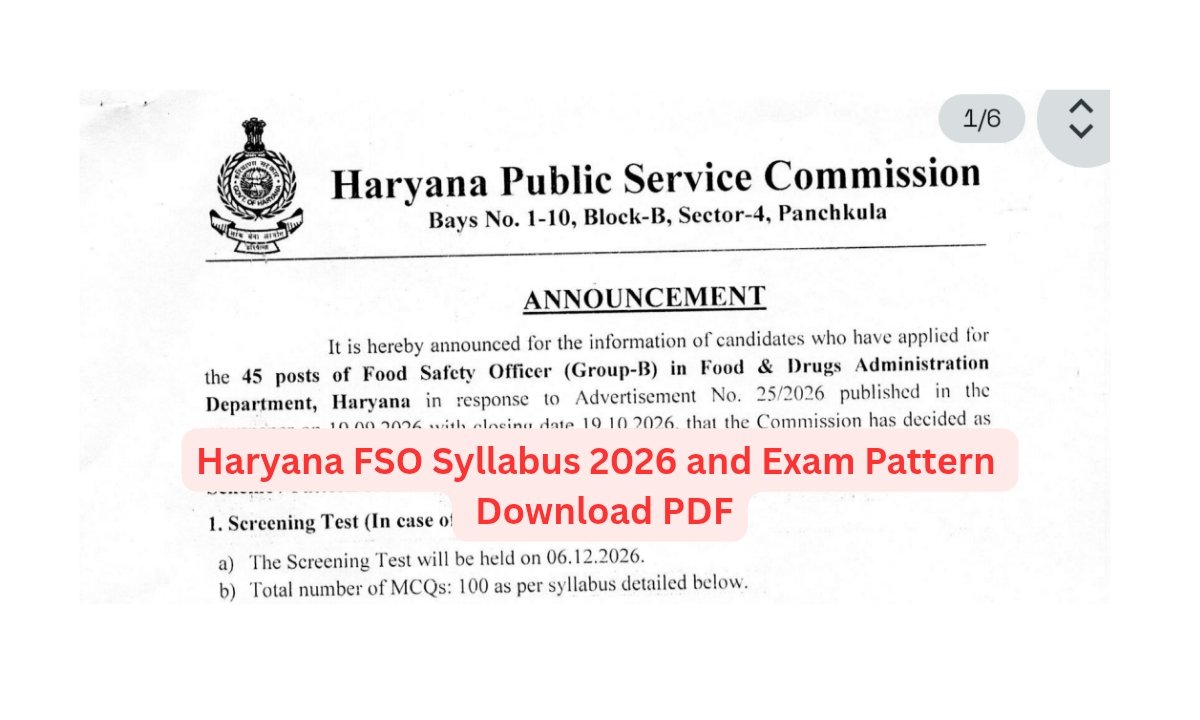
Haryana Public Service Commission (HPSC) has announced the complete scheme and official curriculum for 45 posts of Food Safety Officer (Group-B) under the Food & Drugs Administration Department. Candidates preparing for the selection process need to follow the Haryana FSO syllabus 2026 across three mandatory stages notified by the Commission. The official announcement was issued on hpsc.gov.in as part of Advertisement No. 25/2026.
This page provides the comprehensive subject-wise curriculum, paper scheme, marking scheme, and qualifying criteria for both written examinations. Candidates should check all details in the article below.
Information verified from the official Haryana Public Service Commission announcement dated 14.10.2026. Last verified: 15.10.2026.
The Haryana FSO selection process has 3 stages: Screening Test, Subject Knowledge Test, and Interview. Stage 1 is an objective screening test of 100 questions for 100 marks lasting 2 hours, with one-fourth negative marking. The full topic-wise syllabus for every subject is given below.
Quick Summary of Haryana FSO Syllabus
| Detail | Specification |
|---|---|
| Conducting Body | Haryana Public Service Commission (HPSC) |
| Advertisement No. | 25/2026 |
| Total Vacancies | 45 Posts (Food Safety Officer, Group-B) |
| Selection Stages | Screening Test, Subject Knowledge Test, Interview |
| Screening Mode | Offline OMR Objective MCQs |
| Subject Test Mode | Offline Pen-and-Paper Subjective |
| Papers Counted for Merit | Subject Knowledge Test (87.5%) and Interview (12.5%) |
| Qualifying Papers | Screening Test (25% qualifying cut-off; screening only) |
| Negative Marking | 0.25 mark deducted per wrong or unattempted blank bubble in Screening |
| Medium of Papers | English |
| Application Last Date | 19.10.2026 |
| Official Website | hpsc.gov.in |
Also Read: Haryana Food Safety Officer Recruitment 2026 Notification
Haryana FSO Exam Pattern
The examination consists of three successive stages: a screening test, a descriptive subject knowledge test, and a viva-voce interview. Presence in every stage of examination is mandatory. Any candidate absent in any of the three stages will not be considered for final appointment.
Stage 1: Screening Test
The Commission conducts the Screening Test in case of a large number of applicants to shortlist candidates for the descriptive paper. It will be held on 06.12.2026.
| Section | Questions | Marks | Negative Marking |
|---|---|---|---|
| General Awareness, Mental Ability & Haryana GK | 100 MCQs | 100 Marks | 0.25 mark per wrong or blank answer |
The duration of the Screening Test is 2 hours. All questions carry equal marks. The question paper will be set in English.
Key screening test rules:
- Five Options per Question: Each question contains five options. The fifth option is meant for situations where an applicant intends to leave the question unattempted.
- Negative Marking Rule: One-fourth (0.25) mark will be deducted for each incorrect response.
- Unattempted Deduction: If a candidate neither marks an answer choice nor darkens the fifth circle, one-fourth (0.25) mark will be deducted for every such question.
- Disqualification Rule: Any candidate failing to darken any of the five circles in more than 10% of questions shall be disqualified.
- Cut-off Marks: Candidates must score a minimum of 25% marks to clear the screening stage.
- Shortlisting Ratio: Candidates four times the number of advertised vacancies (along with bracketed candidates) will qualify for the Subject Knowledge Test, provided they secure the 25% threshold.
- Merit Nature: Marks scored in the screening test serve only for shortlisting and are not counted in the final selection merit list.
Stage 2: Subject Knowledge Test
The Subject Knowledge Test will be conducted on 31.01.2027. This descriptive stage forms the core technical assessment.
| Paper | Type | Total Marks | Duration | Qualifying Marks |
|---|---|---|---|---|
| Food Safety Subject Knowledge | Subjective / Conventional | 150 Marks | 3 Hours | 35% |
Key subject test rules:
- Medium: The medium of examination is English.
- Cut-off for Interview: Candidates must obtain a minimum of 35% marks to be eligible for the interview round.
- Calling Ratio: Candidates two times the number of advertised vacancies (plus bracketed candidates) will be called for interview based on merit, subject to the 35% cut-off.
- Merit Weightage: The Subject Knowledge Test carries an 87.5% weightage in the final selection.
Stage 3: Interview / Viva-Voce
The interview round evaluates domain suitability, communication, and practical aptitude. It carries a 12.5% weightage. The final selection merit list is formed by combining the marks of the Subject Knowledge Test (87.5%) and the interview (12.5%).
Also Read: HPSC Food Safety Officer Mock Test and Practice Questions
Haryana FSO Syllabus 2026 for Screening Test
The screening paper checks broad general knowledge, quantitative abilities, and regional awareness through 100 objective questions. The notified topics are:
- General Science
- Current Events of National and International Importance
- History of India
- Indian and World Geography
- Indian Culture, Indian Polity and Indian Economy
- General Mental Ability (Reasoning and Analytical Abilities)
- Basic numeracy (numbers and their relations, order of magnitude etc. Class X level)
- Data interpretation (charts, graphs, tables, data sufficiency etc. Class X level)
- Haryana GK – History, Geography, Polity, Economy, Culture etc.
Subject-wise Syllabus for Subject Knowledge Test
The Subject Knowledge Test follows an exhaustive 12-unit curriculum notified by the Commission for Advt. No. 25 of 2026. Every topic notified in the official syllabus is detailed below:
Unit I: Food Chemistry and Constituents
- Biomolecules and Constituents: Composition, classification, structure and functional properties of carbohydrates, proteins, lipids, water, vitamins, minerals, dietary fibre and naturally occurring food components.
- Physical Chemistry of Foods: Food enzymes and their functions; physical chemistry of foods, including pH, acidity, buffers, water activity, colloids, emulsions and reactions affecting quality and shelf life.
- Processing and Toxicants: Anti-nutritional factors, natural toxicants and their reduction during food preparation and processing; chemical changes during cooking and storage.
Unit II: Human Nutrition and Public Health
- Nutrient Metabolism: Digestion, absorption and metabolism of nutrients; balanced diet, dietary recommendations, energy needs and recommended dietary allowances.
- Nutritional Assessment: Assessment of nutritional status; interpretation and basic calculations for BMI, BMR, biological value, net protein utilization and protein efficiency ratio.
- Deficiencies and Fortification: Macro- and micronutrient deficiencies, malnutrition, food fortification and diet-related non-communicable disease risk; traditional foods and dietary diversity.
- National Programmes: Major nutrition and food-security programmes in India, with names and provisions current at the examination cut-off date.
Unit III: Food Microbiology
- Food Microorganisms: Food-relevant microorganisms: classification, morphology, physiology, growth and survival; sources in raw materials, water, air, equipment and handlers.
- Pathology and Spoilage: Foodborne pathogens, infections, intoxications and toxins; microbial spoilage of major food groups; indicators of microbiological quality.
- Beneficial Microbes: Beneficial microorganisms in food fermentation and their relevance to processing and human nutrition.
- Laboratory Examination: Principles of microbiological examination, culture and enumeration, including standard plate count and indicator-organism tests; interpretation of results.
Unit IV: Primary Production and Food Supply
- Farming Systems: Traditional and modern farming systems in India and Madhya Pradesh; cereals, pulses, oilseeds, millets, horticultural crops, spices and integrated farming.
- Animal Husbandry and Supply Chains: Dairy, meat-animal, poultry, fishery, aquaculture and apiculture production; farm-based livelihoods and supply chains.
- Good Agricultural Practices: Good agricultural and animal husbandry practices; water and soil quality, manure, veterinary medicines, pesticide use, harvesting and post-harvest handling.
- Support Ecosystem: Sustainability, pest management, storage and transport at primary-production level; relevant support roles of ICAR, KVKs, agricultural universities and NABARD.
Unit V: Food Commodities and Product Technology
- Dairy and Animal Products: Composition, quality attributes and processing of milk and milk products; meat, poultry, fish and eggs; hygienic handling and characteristic spoilage.
- Plant Commodities: Quality and processing of cereals, pulses, oilseeds, edible oils, fruits, vegetables, spices and beverages; selected traditional and regional products.
- Standards and Adulteration: Product-specific identity and quality parameters; common adulterants and authenticity concerns across commodity groups.
Unit VI: Preservation, Processing, Packaging and Storage
- Thermal and Physical Preservation: Principles and applications of thermal processing, pasteurization, sterilization, concentration, canning, dehydration, chilling, freezing, irradiation, fermentation and aseptic processing.
- Novel Processing Technologies: Novel and emerging methods: high-pressure processing, membrane separation, pulsed electric fields, cold plasma, microwave, ohmic, dielectric, infrared and induction heating; process limitations and safety implications.
- Additives and Formulation: Hurdle technology, enzymes as processing aids, food additives and their technological functions; nutraceuticals and functional foods.
- Packaging and Shelf Life: Packaging materials, food-contact safety and migration, packaging methods and novel materials; package integrity, shelf life, cold chain and storage controls.
Unit VII: Food Hazards, Hygiene and Safety Management
- Hazard Identification: Biological, chemical, physical and allergen hazards; contaminants, residues, adulterants and food fraud; exposure, health effects and basic risk-analysis concepts.
- Establishment Hygiene: Hygiene in food establishments: contamination routes, potable water, cleaning and sanitation, waste and pest control, personnel hygiene and allergen management.
- Hygiene Frameworks: FSSAI Schedule 4, prerequisite programmes, GMP, GHP, GAP, GLP and good aquaculture/animal production practices, as relevant; HACCP principles and application.
- Management Systems: Food safety management systems and ISO 22000:2018; monitoring, corrective action, verification, validation, documentation, traceability and recall.
Unit VIII: Food Sampling, Analysis and Laboratory Quality
- Sampling Procedures: Field and laboratory sampling plans; representative sampling and basic statistical concepts; sample preparation, preservation, transport, chain of custody and records.
- Analytical Instrumentation: Classical chemical and physical methods; spectroscopic, chromatographic and mass-spectrometric techniques; immunological, molecular and microbiological methods and instrumentation.
- Quality Control: Method selection, validation and verification; calibration, reference materials, internal quality control, proficiency testing, measurement uncertainty and interpretation against specifications.
- Screening Tools: Screening versus confirmatory analysis; FSSAI Rapid Analytical Food Testing (RAFT) kits, equipment and methods for screening and surveillance, including their limitations.
- Laboratory Governance: Food testing laboratory ecosystem, FSSAI methods of analysis, laboratory recognition and the principles of accreditation, including ISO/IEC 17025.
Unit IX: Indian Food Law and Regulatory Compliance
- Statutory Framework: Food Safety and Standards Act, 2006: definitions, authorities, powers, responsibilities, key provisions, offences and penalties; Food Safety and Standards Rules, 2011.
- Regulations: Applicable FSS regulations and amendments: licensing and registration, product standards and additives, contaminants/toxins/residues, packaging, labelling and display, advertising and claims, imports, organic foods, nutraceuticals and other relevant categories.
- Field Enforcement: Food Safety Officer practice: inspection, risk-based surveillance, sampling and seizure procedures, documentation, referrals to Food Analysts, non-compliance, recall, complaints and foodborne-incident response.
- Administrative Hierarchy: Roles of Food Safety Officer, Designated Officer, Food Analyst, Commissioner of Food Safety and other competent authorities; enforcement processes and appeals at overview level.
Unit X: FSSAI Systems, Institutions and Initiatives
- Institutional Structure: Genesis, structure and functions of FSSAI and State Food Authorities: standard setting, enforcement, imports, laboratory networks and third-party food safety audits.
- Consumer and Business Outreach: Training and capacity building; food business guidance, consumer education and social or behavioural change programmes.
- Flagship Schemes: Overview of Eat Right India, food fortification, Clean Street Food Hubs, Safe and Nutritious Food and Repurpose Used Cooking Oil (RUCO), subject to current programme status.
- Allied Organizations: Roles of relevant Indian institutions and bodies, including BIS, AGMARK, APEDA, EIC, MPEDA, Spices Board, CFTRI, NIFTEM, ICAR, ICMR and DFRL.
Unit XI: International Food Control and Standards
- Codex Framework: Codex Alimentarius Commission: purpose, standard setting, committees and the scientific advisory roles of JECFA, JEMRA and JMPR.
- Trade Agreements: WTO sanitary and phytosanitary (SPS) and technical barriers to trade (TBT) agreements; overview of international food-control systems.
- Standard Harmonisation: Principles and roles of national and international standards, certification, auditing and accreditation bodies; distinction between voluntary standards and legal requirements.
Unit XII: Food Biotechnology and Emerging Developments
- Bioprocessing: Principles of biotechnology; fermentation, industrial bioprocessing, enzyme production and immobilization, downstream processing and applications in foods and food testing.
- Genetic Engineering: Basic genetic engineering and molecular detection principles; GM foods and applicable biosafety and regulatory considerations.
- Emerging Trends: Emerging food-safety hazards, rapid diagnostics and new processing approaches; recent FSSAI regulations, standards, initiatives, government schemes and public-health or nutrition developments.
- Regulatory Cut-off Principles: Identify official sources, notification and effective dates; distinguish binding requirements from drafts, advisories and proposals at the examination cut-off date.
How to Plan Study with Haryana FSO Syllabus 2026
Planning preparation for this two-stage written examination requires separating qualifying requirements from merit scoring:
- Prioritise the Descriptive Merit Core: The Subject Knowledge Test accounts for 87.5% of your final selection marks. Because this paper is subjective, simple multiple-choice familiarity is insufficient. Candidates should practice descriptive answer structuring, flowcharts for manufacturing technologies, and legal definitions verbatim from the FSS Act, 2006.
- Build Foundations in Chemistry and Microbiology First: Begin with Unit I (Food Chemistry) and Unit III (Food Microbiology). These two units establish the biochemical baseline needed to master Unit V (Commodities), Unit VI (Preservation), and Unit VII (Safety Management).
- Master Regulatory Laws and FSSAI Guidelines: Units IX and X represent statutory work handled daily by an active Food Safety Officer. Study sections of the FSS Act, 2006, enforcement powers, search and seizure rules, and recent operational programmes like RUCO and Eat Right India.
- Prepare Screening Paper Concurrently: The screening paper requires 25% marks to qualify, but candidates must rank within four times the vacancies to write the main exam. Dedicate daily revision time to Haryana GK, general science, and basic arithmetic to ensure qualification on 06.12.2026.
- Solve Previous Papers for General Studies: Review standard state commission question sets across the Syllabus section and evaluate past trends through Previous Question Papers to fine-tune speed and mental ability accuracy. Candidates tracking regional recruitment opportunities can explore upcoming state tests on the Haryana Jobs portal.
This is added context, not part of the official syllabus. Confirm with the official website.
Important Links
| Details | Link |
|---|---|
| HPSC Food Safety Officer Scheme and Syllabus Notice (PDF) | Download Official Syllabus PDF |
| HPSC Official Examination Portal | Visit HPSC Website |
| HPSC Latest Recruitment Updates | Haryana Public Service Commission Jobs |
Frequently Asked Questions
What is the marking scheme for the Haryana FSO syllabus 2026 screening test?
The Screening Test carries 100 questions for 100 marks with 0.25 negative marking for each incorrect answer. If a question is left unattempted without darkening the fifth bubble, 0.25 mark is also deducted. Leaving more than 10% questions completely unbubbled leads to disqualification.
Are screening test marks added to the final merit list?
No, the screening test is qualifying and shortlisting in nature. Its marks are not counted toward the final merit list. Final selection is determined solely by the Subject Knowledge Test (87.5% weightage) and the Interview (12.5% weightage).
What is the medium and duration of the Subject Knowledge Test?
The Subject Knowledge Test is conducted in English as a conventional subjective paper. The total marks are 150, and the duration is 3 hours. Candidates must secure at least 35% marks to become eligible for the interview stage.
When will the HPSC Food Safety Officer examinations be held?
According to the official announcement, the screening test is scheduled for 06.12.2026, while the descriptive Subject Knowledge Test is scheduled for 31.01.2027.
Haryana FSO syllabus 2026: full topic-wise list for screening and subject papers, exam pattern, marks and negative marking, from the official notice.

Written and verified by
Sandeep Khati
Founder and Editor, India Job Alerts
B.Tech in Computer Science from Jalpaiguri Government Engineering College (2010). Former Systems Engineer at TCS and in digital publishing since 2011. He started India Job Alerts in April 2025 to publish verified government and PSU job notifications for West Bengal, Sikkim and the rest of India. Every post is checked against the official notification before it goes live. Also writes about the Darjeeling hills at SearchDarjeeling.