
NTPC Assistant Executive Operation Syllabus 2026 has been released for the Assistant Executive (Operation) – Fixed Term Basis post under Advertisement No. 05/26. If you have applied or are planning to apply for this post, this is your most important read before you start your preparation. The exam is divided into two parts — a general aptitude section and a technical section based on your discipline. Make sure you go through this article carefully and also download the official notification before beginning your studies.
How many questions are in NTPC AEO 2026 exam??
“The NTPC AEO 2026 exam has 120 questions in two parts: Part A (50 Aptitude questions – common for all) and Part B (70 Technical questions – Electrical or Mechanical). Based on Advertisement No. 05/26.”
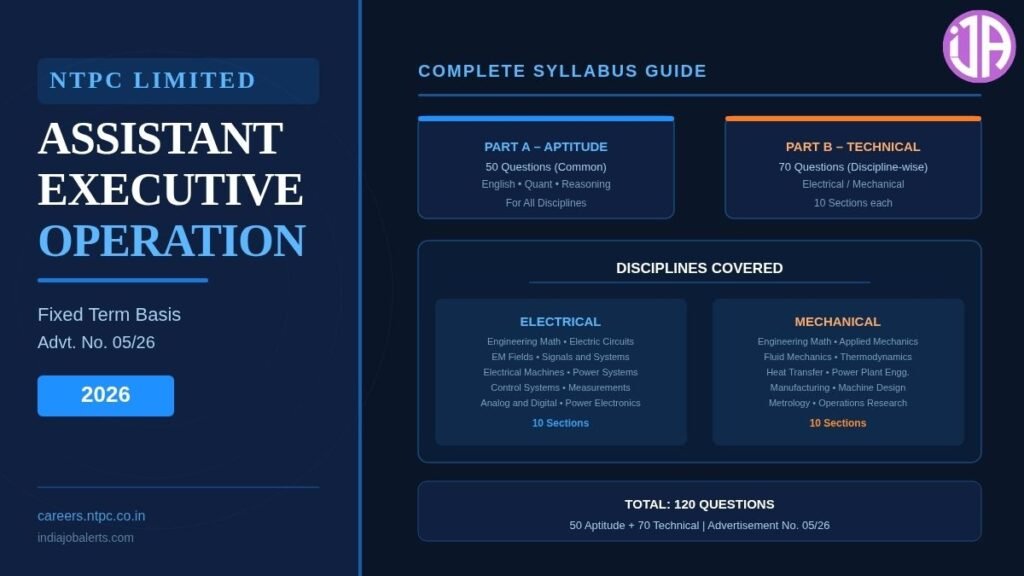
Information verified from official NTPC notification No. 05/26 — Indicative Syllabus for Assistant Executive (Operation) Fixed Term Basis.
Table Contents
Quick Summary – NTPC AEO Syllabus 2026
| Category | Details |
|---|---|
| Organisation / Employer | NTPC Limited |
| Name of the Post | Assistant Executive (Operation) – Fixed Term Basis |
| Advertisement No. | 05/26 |
| Disciplines | Electrical, Mechanical |
| Exam Structure | Part A (Aptitude) + Part B (Technical) |
| Total Questions | 120 (50 Aptitude + 70 Technical) |
| Government / Private / Contract | Contract Based (Fixed Term) |
| Official Website | careers.ntpc.co.in |
| Exam / Interview Date | Date will be intimated to shortlisted candidates |
Also Read | UPSC Notification 04/2026 | DRDO SAO Grade-II Vacancy 2026
About NTPC Limited
NTPC Limited (National Thermal Power Corporation) is India’s largest power generation company under the Ministry of Power, Government of India. Their mission is to provide reliable and sustainable power to the nation. Candidates selected under this recruitment will be part of NTPC’s operation teams at its power plants across India. For more, visit NTPC Official Website.
Vacancy Details & Eligibility – NTPC AEO Fixed Term 2026
The eligibility criteria for the Assistant Executive (Operation) – Fixed Term post include education qualifications specific to the Electrical and Mechanical disciplines. Candidates should make sure they meet all the conditions required by NTPC before applying.
Educational Qualification:
- Electrical Discipline: Not mentioned in the official notification (refer to the main recruitment advertisement No. 05/26)
- Mechanical Discipline: Not mentioned in the official notification (refer to the main recruitment advertisement No. 05/26)
Age Limit: Not mentioned in the official notification (refer to the main recruitment advertisement No. 05/26)
Syllabus & Exam Pattern – NTPC AEO 2026 (Advt. No. 05/26)
This is the section most candidates have been waiting for. NTPC has published an indicative syllabus for the Assistant Executive (Operation) Fixed Term written test. The exam has two parts — Part A is common for all disciplines, and Part B is technical and discipline-specific. Understanding the structure clearly will help you plan your preparation better and avoid wasting time on irrelevant topics.
Exam Structure:
- Part A – Aptitude (50 Questions) – Common for All Disciplines
- Part B – Technical (70 Questions) – Discipline-wise (Electrical / Mechanical)
Part A – Aptitude Section (50 Questions)
This part is common for both Electrical and Mechanical disciplines.
- Verbal Ability / General English
- Quantitative Aptitude
- Reasoning Ability
Part B – Technical Section (70 Questions)
For Electrical Discipline
Section 1: Engineering Mathematics
- Linear Algebra: Matrix algebra, systems of linear equations
- Calculus: Functions of single variable, limits, continuity, differentiability, mean value theorems, definite and improper integrals, double and triple integrals
- Differential Equations: First order equations (linear and nonlinear), higher order linear differential equations with constant coefficients, Euler-Cauchy equation, initial and boundary value problems, Laplace transforms, solutions of heat, wave and Laplace’s equations
- Probability and Statistics: Definitions of probability, sampling theorems, conditional probability, mean, median, mode, standard deviation, random variables, binomial, Poisson and normal distributions
- Numerical Methods: Numerical solutions of linear and non-linear algebraic equations
Section 2: Electric Circuits
- Network elements: Ideal voltage and current sources, dependent sources, R, L, C, M elements
- Network solution methods: KCL, KVL, Node and Mesh analysis
- Network Theorems: Thevenin’s, Norton’s, Superposition and Maximum Power Transfer theorem
- Transient response of DC and AC networks, sinusoidal steady-state analysis, resonance, two-port networks, balanced three-phase circuits, star-delta transformation, complex power and power factor in AC circuits
Section 3: Electromagnetic Fields
- Coulomb’s Law, Electric Field Intensity, Electric Flux Density, Gauss’s Law, Divergence
- Electric field and potential due to point, line, plane and spherical charge distributions
- Effect of dielectric medium, Capacitance of simple configurations
- Biot-Savart’s law, Ampere’s law, Curl, Faraday’s law, Lorentz force
- Inductance, Magnetomotive force, Reluctance, Magnetic circuits, Self and Mutual inductance
Section 4: Signals and Systems
- Representation of continuous and discrete time signals, shifting and scaling properties
- Linear time invariant and causal systems
- Fourier series for continuous and discrete time periodic signals, sampling theorem
- Applications of Fourier Transform, Laplace Transform and Z-transform
- RMS value, average value calculation for general periodic waveforms
Section 5: Electrical Machines
- Single-phase transformer: equivalent circuit, phasor diagram, open circuit and short circuit tests, regulation and efficiency
- Three-phase transformers: connections, vector groups, parallel operation
- Auto-transformer, electromechanical energy conversion principles
- DC machines: separately excited, series and shunt, motoring and generating modes, speed control
- Three-phase induction machines: principle of operation, types, performance, torque-speed characteristics, starting and speed control
- Single-phase induction motors
- Synchronous machines: cylindrical and salient pole machines, regulation, parallel operation of generators, starting of synchronous motors
- Types of losses and efficiency calculations
Section 6: Power Systems
- Basic concepts of electrical power generation, AC and DC transmission
- Models and performance of transmission lines and cables
- Economic Load Dispatch (with and without transmission losses)
- Series and shunt compensation, electric field distribution and insulators
- Distribution systems, per-unit quantities, bus admittance matrix
- Gauss-Seidel and Newton-Raphson load flow methods
- Voltage and frequency control, power factor correction
- Symmetrical components, symmetrical and unsymmetrical fault analysis
- Over-current, differential, directional and distance protection; circuit breakers
- System stability concepts, equal area criterion
Section 7: Control Systems
- Mathematical modelling, feedback principle, transfer function
- Block diagrams and signal flow graphs
- Transient and steady-state analysis of LTI systems
- Stability analysis using Routh-Hurwitz and Nyquist criteria, Bode plots, Root loci
- Lag, Lead and Lead-Lag compensators; P, PI and PID controllers
- State space model, solution of state equations of LTI systems
Section 8: Electrical and Electronic Measurements
- Bridges and Potentiometers
- Measurement of voltage, current, power, energy and power factor
- Instrument transformers, digital voltmeters and multimeters
- Phase, time and frequency measurement; oscilloscopes
- Error analysis
Section 9: Analog and Digital Electronics
- Simple diode circuits: clipping, clamping, rectifiers
- Amplifiers: biasing, equivalent circuit and frequency response
- Oscillators and feedback amplifiers
- Operational amplifiers: characteristics and applications
- Single-stage active filters, Sallen-Key, Butterworth filters
- VCOs and timers, combinatorial and sequential logic circuits
- Multiplexers, demultiplexers, Schmitt triggers, sample and hold circuits
- A/D and D/A converters
Section 10: Power Electronics
- Static V-I characteristics and firing/gating circuits for Thyristor, MOSFET, IGBT
- DC to DC conversion: Buck, Boost and Buck-Boost converters
- Single and three-phase uncontrolled rectifiers
- Voltage and current commutated Thyristor based converters
- Bidirectional AC to DC voltage source converters
- Power factor and Distortion Factor of AC to DC converters
- Single-phase and three-phase voltage and current source inverters, sinusoidal pulse width modulation
Also Read | NEEPCO Recruitment 2026 – Executive Trainee Jobs
For Mechanical Discipline
Section 1: Engineering Mathematics
- Linear Algebra: Matrix algebra, systems of linear equations
- Calculus: Functions of single variable, limits, continuity, differentiability, mean value theorems, definite and improper integrals, double and triple integrals
- Differential Equations: First order equations (linear and nonlinear), higher order linear differential equations with constant coefficients, Euler-Cauchy equation, initial and boundary value problems, Laplace transforms
- Probability and Statistics: Definitions of probability, sampling theorems, conditional probability, mean, median, mode, standard deviation, random variables, binomial, Poisson and normal distributions
- Numerical Methods: Numerical solutions of linear and non-linear algebraic equations
Section 2: Applied Mechanics and Design
- Engineering Mechanics: Free-body diagrams, equilibrium, friction (rolling, belt-pulley, brakes, clutches, screw jack, wedge), trusses and frames, virtual work, kinematics and dynamics of rigid bodies, impulse and momentum, Lagrange’s equation
- Mechanics of Materials: Stress and strain, elastic constants, Poisson’s ratio, Mohr’s circle, thin cylinders, shear force and bending moment diagrams, bending and shear stresses, deflection of beams, torsion of circular shafts, Euler’s theory of columns, energy methods, thermal stresses, strain gauges and rosettes
- Theory of Machines: Displacement, velocity and acceleration analysis of plane mechanisms, dynamic analysis of linkages, cams, gears and gear trains, flywheels and governors
- Vibrations: Free and forced vibration of single degree of freedom systems, damping, vibration isolation, resonance, critical speeds of shafts
- Machine Design: Design for static and dynamic loading, failure theories, fatigue strength, SN diagram, design of machine elements — bolted, riveted and welded joints, shafts, gears, rolling and sliding contact bearings, brakes and clutches, springs
Section 3: Fluid Mechanics and Thermal Sciences
- Fluid Mechanics: Fluid properties, fluid statics, forces on submerged bodies, stability of floating bodies, control-volume analysis, Bernoulli’s equation, dimensional analysis, viscous flow, boundary layer, flow through pipes, basics of compressible fluid flow
- Heat Transfer: Modes of heat transfer, one-dimensional heat conduction, heat transfer through fins, unsteady heat conduction, convective heat transfer, heat exchanger performance (LMTD and NTU methods), radiative heat transfer, Stefan-Boltzmann law, Wien’s displacement law
- Thermodynamics: Thermodynamic systems and processes, properties of pure substances, ideal and real gas behaviour, zeroth and first laws, second law, thermodynamic property charts and tables, availability and irreversibility
- Applications — Power Engineering: Air and gas compressors, vapour and gas power cycles, regeneration and reheat; IC Engines: Otto, Diesel and dual cycles; Refrigeration and air-conditioning: vapour and gas refrigeration, psychrometric chart; Turbomachinery: impulse and reaction principles, Pelton-wheel, Francis and Kaplan turbines, steam and gas turbines
Section 4: Materials, Manufacturing and Industrial Engineering
- Engineering Materials: Structure and properties of engineering materials, phase diagrams, heat treatment, stress-strain diagrams
- Casting, Forming and Joining Processes: Types of castings, design of patterns, moulds and cores, solidification and cooling, plastic deformation, hot and cold working, forging, rolling, extrusion, drawing, welding, brazing, soldering, adhesive bonding
- Machining and Machine Tool Operations: Mechanics of machining, basic machine tools, cutting tools, tool life and wear, economics of machining, non-traditional machining, NC/CNC machines and CNC programming
- Metrology and Inspection: Limits, fits and tolerances, linear and angular measurements, comparators, interferometry, form and finish measurement, tolerance analysis
- Production Planning and Control: Forecasting models, aggregate production planning, scheduling, materials requirement planning, lean manufacturing
- Operations Research: Linear programming, simplex method, transportation, assignment, network flow models, PERT and CPM
- Power Plant Engineering: Steam generators, steam turbines, condensers, feed water and circulating water systems, combustion mechanism, Rankine cycle, plant capacity, plant load factor, utilization factor, economics of power generation, types of power plants, CFBC boiler, PF boiler, efficiency, heat rate
Also Read | UPSC Notification 04/2026 | DRDO SAO Grade-II Vacancy 2026
Selection Process – NTPC AEO Fixed Term Recruitment
NTPC has not specifically detailed the complete selection process in the indicative syllabus document. However, based on the nature of the examination and the disciplines mentioned, the likely selection process will include a written test. Staying well-prepared and checking the official notification for any updates is always a good idea — competition for NTPC posts has been high in recent years.
- Written Test (Part A: Aptitude + Part B: Technical)
- Document Verification / Medical Examination (as per official notification No. 05/26 — detailed process not mentioned in the syllabus document)
Important Links – NTPC Official Website
Candidates applying for the Assistant Executive (Operation) post are advised to visit these important links for downloading the official PDF Syllabus
| Resource | Link |
|---|---|
| Official Notification PDF | Download Official Notification PDF – NTPC AEO Syllabus Advt. 05/26 |
FAQs – NTPC Assistant Executive Operation Syllabus 2026
1. Is the syllabus for Electrical and Mechanical disciplines the same for NTPC AEO 2026?
No. Part A (Aptitude) is common for both disciplines. Part B (Technical) is discipline-specific — Electrical candidates answer Electrical Engineering topics and Mechanical candidates answer Mechanical Engineering topics.
2. How many total questions are there in the NTPC AEO written exam?
There are 120 questions in total — 50 questions in Part A (Aptitude) and 70 questions in Part B (Technical), as per the indicative syllabus for Advt. No. 05/26.
3. Is Engineering Mathematics included in the NTPC AEO 2026 exam?
Yes. Engineering Mathematics is Section 1 of Part B for both Electrical and Mechanical disciplines, covering topics like Linear Algebra, Calculus, Differential Equations, Probability, and Numerical Methods.
4. What books are recommended for NTPC AEO Electrical preparation?
The official notification does not recommend specific books. However, standard textbooks for GATE Electrical Engineering cover most of the topics listed in the NTPC AEO indicative syllabus and are a reliable reference.
5. Is this a permanent government job or a fixed-term contract?
This is a Fixed Term Basis post, as clearly stated in Advertisement No. 05/26. It is not a permanent government job. Candidates should check the official notification for the contract duration and other service conditions.
About the Author

Sandeep Khati is the founder of India Job Alerts and a B.Tech in Computer Science from JGEC (2010). He started his career as a Systems Engineer at TCS and has been active in digital publishing since 2011, beginning with SearchDarjeeling.com(2011) and working as a web developer and designer at Darjeeling Informatics. Launched in April 2025, India Job Alerts is his most focused project — dedicated to publishing verified government and PSU job notifications for West Bengal, Sikkim, and All-India candidates. Every post is cross-checked against official notifications before publishing.. Know more