
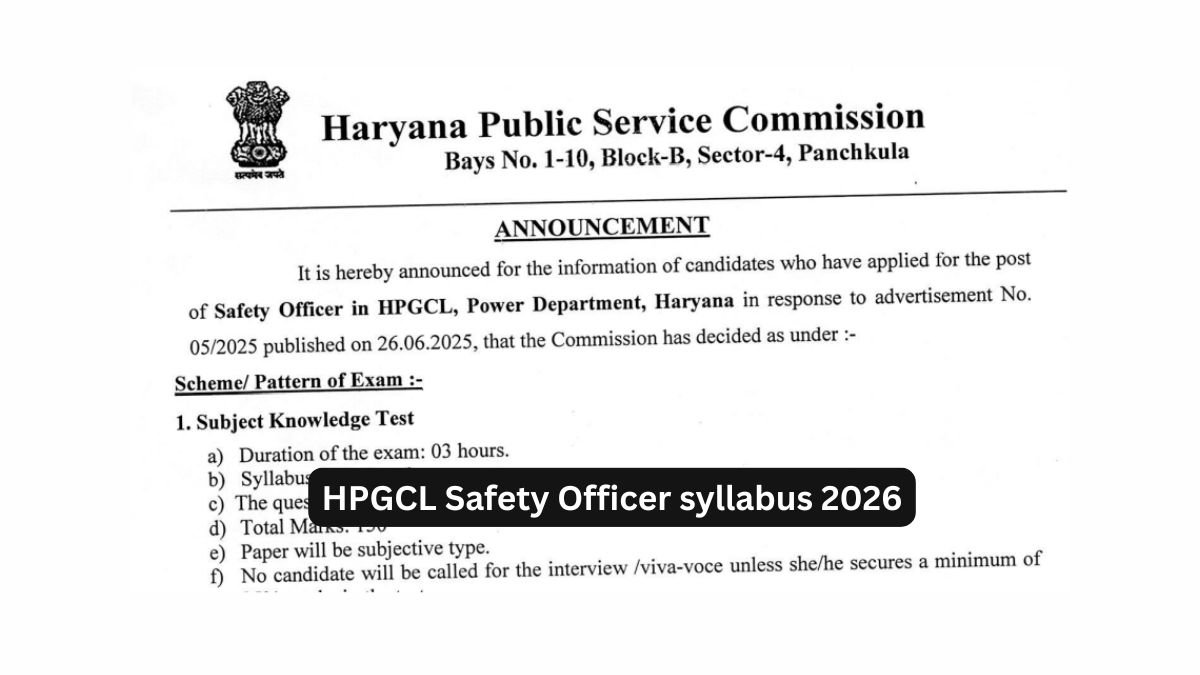
The Haryana Public Service Commission (HPSC) released the HPGCL Safety Officer syllabus and exam pattern on 28 September 2026.
It applies to advertisement No. 05/2025, published on 26 June 2025, for the Safety Officer post in HPGCL, Power Department, Haryana. Recruitment has two stages, a Subject Knowledge Test and an interview.
This page lists the full HPGCL Safety Officer syllabus, with every topic in the order and wording of the notice on hpsc.gov.in. It also gives the exam pattern and the final merit rule. Candidates should check all details in the article below.
Information verified from the official HPSC notice dated 28 September 2026. Last verified: 28 September 2026.
Recruitment for the Safety Officer post has 2 stages. The Subject Knowledge Test is a 3-hour subjective paper of 150 marks in English. A candidate needs 35% marks in it to reach the interview. The full topic list for all 9 subjects is given below.
Quick Summary of HPGCL Safety Officer Syllabus
| Detail | Information |
|---|---|
| Conducting Body | Haryana Public Service Commission (HPSC) |
| Post | Safety Officer in HPGCL, Power Department, Haryana |
| Advertisement | No. 05/2025, published on 26 June 2025 |
| Stages | Subject Knowledge Test, then interview |
| Paper Type | Subjective |
| Duration | 3 hours |
| Total Marks | 150 |
| Medium | English |
| Interview Call | Minimum 35% in the test |
| Merit Weightage | Test 87.5%, interview 12.5% |
| Official Website | hpsc.gov.in |
HPGCL Safety Officer Exam Pattern
Subject Knowledge Test
The Commission tests the HPGCL Safety Officer syllabus through one written paper.
| Item | Detail |
|---|---|
| Duration | 3 hours |
| Total Marks | 150 |
| Paper Type | Subjective |
| Question Paper | English |
| Weightage | 87.5% |
The Commission will call a candidate for the interview only if the candidate secures at least 35% marks in the test.
The Commission will call 3 times the number of advertised posts for the interview, including bracketed candidates, if any. Each of them must have secured the 35% cut-off marks.
Interview and final merit list
The interview carries 12.5% weightage. Attendance at each stage is mandatory.
The Commission will prepare the final merit list by adding the marks of the Subject Knowledge Test and the interview. Candidates can follow other openings on the latest jobs across India page.
Also Read: Haryana Food Safety Officer 2026 – 45 Vacancies
Subject-Wise HPGCL Safety Officer Syllabus
The notice lists 9 subjects. The topics below keep the order and spelling printed in the notice, and no topic is left out. Candidates can find syllabus pages for other exams in the latest syllabus updates.
1. National and International scenario of Skill Development
- Vocational Education System in India
- Current National Policy on Skill Development in India
- Objective and Need for Skill Development in India
- Recommendations of various Committees on Vocational Education
- Scope of Skill Development
2. Academic and Administrative Management
- Organiation structure of Government ITI’s,
- Reporting systems, reporting authorities and General Administration
- SWOT analysis, Vision and mission, goals, Strategic Planning, Internal/external environment management, Resource mobilization, library management, maintenance of academic facilities.
- Problem solving techniques, personal management, value analysis, faculty norms
3. Skill Development Schemes
- Various Skill Development Schemes run by Central and State Government like Craftsmen Training Scheme,
- Pradhan Mantri Kaushal Vikas Yojana (PMKVY), National Skill Qualification Framework (NSQF), State Skilling Schemes.
- Crafts Instructor Training Schemes (CITS).
- National Apprentice Promotion Schemes (NAPS)
- SANKALP Scheme, STRIVE Scheme
4. Engineering Mechanics and Engineering Drawing
- Force and System of forces, equilibrium of rigid bodies, free body diagram, Lami’s theorem. Laws of Coulomb friction, Equilibrium of bodies involving dry friction, belt friction. Centre of Gravity and moment of inertia.
- Stress of strain: Concept of stress and strain, simple stresses, tensile, compressive, shear, bending and torsion, stress-strain curves, elastic constants.
- Engineering Graphics/Technical Drawing: Drawing equipments and use of Instruments, Conventions in drawing practice, Dimensioning, Scales.
- Theory of Projection of Planes and Solids, Orthographic Projection.
5. Fundamentals of Thermal Science
- Introduction to thermodynamics, Properties, forms of energy, thermodynamic systems, steady flow systems,
- Types of work, thermodynamic processes, laws of thermodynamics, Carnot theorem
- Concept of enthalpy & entropy
- Introduction to I.C. Engines: Two, four stoke S.I. and C.I. engines. Otto cycle, Diesel cycle.
- Basic idea of Refrigeration and Air Conditioning Cycle.
6. Basic Knowledge on Workshop Science
- Measuring instruments & gauges, Introduction to manufacturing processes, Basic terminology used. Materials properties and their application: Different engineering materials, Properties, Nomenclature, Basics of heat treatment.
- Fitting: Introduction, Tools used in fitting, measuring and marking, sawing, Filing, Tapping and die, Introduction to drills.
- Welding: brief introduction, Electric Arc, Gas welding process and equipment, Soldering and Brazing process. Types of sheets (ferrous/non-ferrous), Standard sheet sizes and their measurement, Tools used in sheet metal.
- Metal Cutting: Introduction, Classification of machine tool and cutting tools, Basic operations on lathe, Drilling, Shaper, Milling, Cutting tool material, Work-holding devices, Cutting parameters i.e. speed, feed and depth of cut.
- Casting: Pattern types, moulding sand and its properties, casting process and defects.
7. Basic Electrical Science
- Network Laws and Theorems: Network Laws for D.C. networks-Kirchhoff’s laws, network elements, Superposition theorem, Thevenin’s and Norton’s Theorems, Maximum Power Transfer Theorem.
- Single Phase A.C. Circuits: Single-phase EMF generation, form factor, peak factor, rms value, areage value, Phasor diagram, Resistive, Inductive and Capacitive circuits. A.C. series and parallel circuits. Analysis of simple RLC-series circuits, Resonance, Q factor, Three Phase A.C. Circuits (General relations)
- Magnetic Circuits and Transformers: Analogy between electric and magnetic circuits, Magnetic Circuits, B-H Curve, Hysteresis Loop, Inductances in series and parallel, Hysteresis and Eddy current losses.
- Transformers- constructional details. EMF equation, rating and phasor diagram on no-load and loaded conditions.
- Electrical Machines: Three phase Induction motors construction, principle of working and their applications. Electrical Instruments: Basic principles of Moving iron, PMMC, dynamometer and Induction type instruments, torque equation, Dynamometer type Wattmeter.
8. Basic Electronics & Communication Science
- Electronics instruments: Role and importance of general-purpose test instruments, CRO, CRT, Semiconductor Diodes and Applications, Review of PN Junction Diode, V-I Characteristics, Ideal Diodes, LED, Tunnel Diode, Photodiode.
- Halfwave, Fullwave and Bridge rectifiers, Passive filters, Regulators, Line regulation and load regulation, Zener Diode as voltage regulator, concept of switched mode power supply (SMPS), Bipolar Junction Transistor, FET, MOSFET.
- Operational Amplifiers, Applications of op-amp as summing amplifier, differentiator and integrator. Digital Electronics: Number system and logic gates, NAND and NOR as universal gates, SR and JK flip-flops.
- Introduction to Computers: Generation of computers, Characteristics and classifications of computers. Components of Computers, Types of memory, Computer Software and their types, Operating System, Algorithm and flow chart.
- Computer Networks & Communication: LAN, MAN, WAN, Network Topologies, Modes of Data Communication. Introduction to Internet and its Safeguard, Router, switches, Hub, Bridges.
9. Civil
- Surveying instruments and their uses, various civil engineering survey, building by-laws. Properties and tests on construction materials like bricks, cement, course aggregate, steel reinforcement.
- Units of different fluid properties, type of fluid and types of flow, flow measurement.
- Construction management techniques like bar chart, milestone, network CPM/PERT, construction equipments, notice inviting tender, administrative approval, technical sanction, specification.
- Test on water and waste water, environment protection act, sources of air pollution, National clean air program.
- Types of dams and canals, rain fall measurement, safe bearing capacity of soil, methods of building estimates, forms used in public works department.
Also Read: Canara Bank Apprentice 2026 – 3500 Seats – No Exam, Merit-Based Selection
How to Plan Study with This Syllabus
The notice gives no marks split between the 9 subjects. Candidates should give each subject a fair share of time, because the paper is subjective and the syllabus covers all of them.
A plan for the HPGCL Safety Officer syllabus works best when it starts with subjects that build on each other. Basic Electrical Science comes before Basic Electronics & Communication Science. Engineering Mechanics comes before the drawing and projection topics.
Because the test is subjective, candidates should practise writing full answers within the 3-hour limit. Timed writing matters more in the last weeks than one more reading of the list.
Previous question papers from earlier recruitment exams show how technical topics are usually asked. Candidates can read previous question papers next to the HPGCL Safety Officer syllabus. This helps mark any topic that is hard to answer in writing.
The 35% mark only decides who gets an interview call. The final merit list adds the test marks and the interview marks, and the test carries the larger weightage. A candidate who finishes the syllabus early can use the extra time for revision.
This is added context, not part of the official syllabus. Confirm with the official website.
Also Read: UPSC Recruitment Advt No 12/2026 – 13 Posts, Last Date 16 Oct
Important Links
| Details | Link |
|---|---|
| Syllabus and exam pattern notice | Download HPSC syllabus and exam pattern notice PDF |
| More government jobs | Latest government job updates |
FAQs
What is in the HPGCL Safety Officer syllabus?
The syllabus has 9 subjects. These are the national and international scenario of skill development, academic and administrative management, and skill development schemes. The rest cover engineering mechanics and drawing, thermal science, workshop science, electrical science, electronics and communication science, and civil.
Is the HPGCL Safety Officer paper objective or subjective?
The Subject Knowledge Test is a subjective paper of 150 marks. It runs for 3 hours, and the question paper will be in English. The Commission has enclosed the HPGCL Safety Officer syllabus with the notice.
What are the minimum marks for the interview call?
A candidate needs at least 35% marks in the Subject Knowledge Test to be called for the interview. The Commission will call 3 times the number of advertised posts, including bracketed candidates, if any. All of them must have secured the 35% cut-off.
How is the final merit list prepared?
The Commission adds the marks of the Subject Knowledge Test and the interview. The test carries 87.5% weightage and the interview carries 12.5%. Candidates must attend both stages, since attendance at each stage is mandatory.

ABOUT THE AUTHOR
I’m Sandeep Khati, founder of India Job Alerts. I completed my B. Tech. in Computer Science from Jalpaiguri Government Engineering College (JGEC) in 2010, then worked as a Systems Engineer at TCS. I moved into digital publishing in 2011, starting with SearchDarjeeling.com and later working as a web developer and designer at Darjeeling Informatics.
I launched India Job Alerts in April 2025. It’s my most focused project yet, built to publish verified Government and PSU job notifications for candidates in West Bengal, Sikkim, and across India. Before any post goes live, I personally check it against the official notification. Know more