
Government job notifications reserve a share of posts for the OBC, SC, ST, EWS and PwBD categories, and each reservation needs its own certificate to claim it. Candidates often lose a reservation benefit not because they are ineligible, but because the wrong certificate, an expired one, or one in the wrong format was uploaded. Category Certificates for Government Jobs guide explains what each certificate means, who issues it, how long it stays valid, and where to apply.
This is a general guide to how these certificates work, not a report on one recruitment notice. The exact certificate format, cut-off date, and category rules for any specific vacancy are set by the recruiter, so candidates should always confirm the requirements in the official notification before applying.
An OBC-NCL certificate confirms both caste and family income, and for central government jobs, it must be renewed every financial year. An SC or ST caste certificate, once issued, is generally valid for life and does not need renewal. An EWS certificate must be issued for the current financial year and confirms family income and property limits for General category candidates. A PwBD certificate is issued by a government medical authority and certifies a disability of 40% or more, the threshold that qualifies as a “benchmark disability” under law. All four are issued by a Tehsildar, Sub-Divisional Magistrate, District Magistrate or, for PwBD, a government hospital’s medical board.
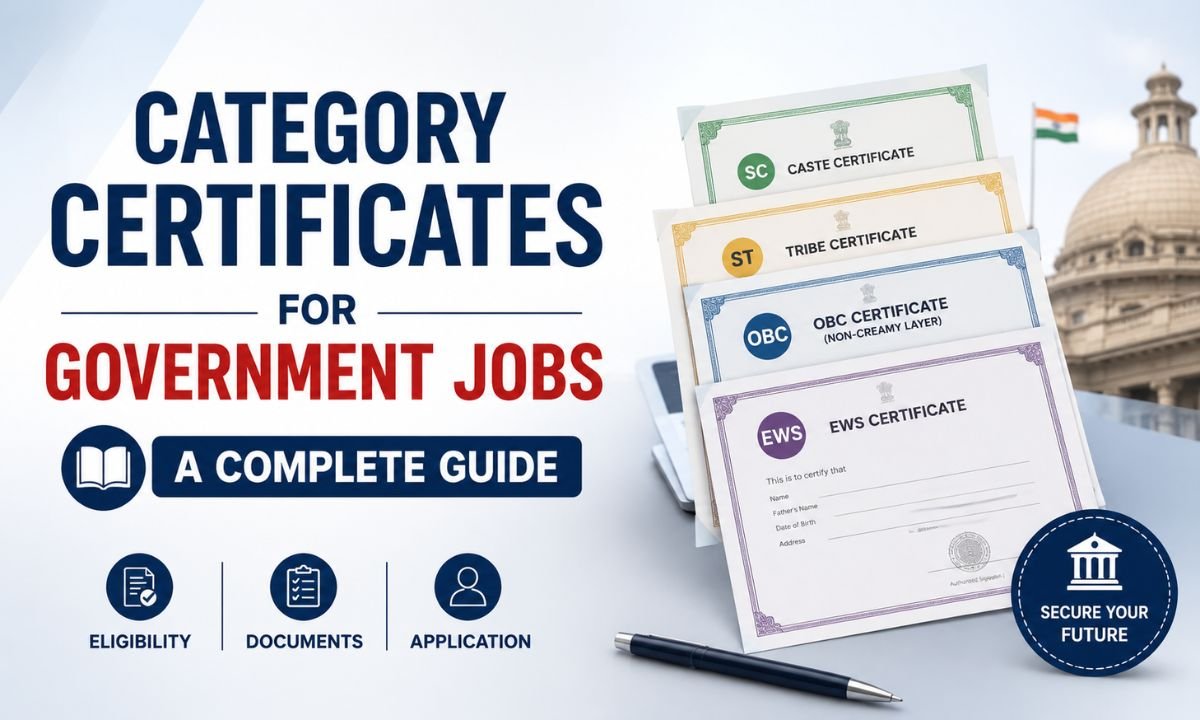
At a Glance: The Four Certificates
| Certificate | Who it is for | Typical issuing authority | Typical validity |
|---|---|---|---|
| SC / ST certificate | Candidates from a Scheduled Caste or Scheduled Tribe listed for their state | Tehsildar / SDM / District Magistrate | Generally lifelong; no renewal needed |
| OBC-NCL certificate | OBC candidates outside the “creamy layer” income and status limits | Tehsildar / SDM / District Magistrate | One financial year for central government use; renewal needed each year |
| EWS certificate | General category candidates below the income and asset limits | Tehsildar / SDM / District Magistrate | Current financial year only; a certificate from an earlier year is not accepted |
| PwBD certificate / UDID card | Candidates with a benchmark disability of 40% or more | Government hospital medical board (via the UDID portal) | Lifelong for a permanent disability; five years for a temporary or progressive one, then renewal |
Also Read: How to Apply for a Government Job in 2026: Full Guide
What Each Category Certificate Means
SC / ST Certificate
This certifies that a candidate belongs to a caste or tribe listed as Scheduled Caste or Scheduled Tribe for their state under the Constitution. Once issued, it does not carry an income test and generally does not expire, though some recruiters ask for a certificate re-verified or issued after a certain date if the original is very old or the family has moved states.
OBC-NCL Certificate
An OBC candidate needs two things confirmed on this certificate: that their caste appears on the Central List of OBCs maintained by the National Commission for Backward Classes, and that the family falls in the “non-creamy layer” — meaning they are below the income and status limits that would otherwise exclude them from reservation. A plain OBC caste certificate without the non-creamy layer confirmation is not accepted for central government recruitment; candidates need the specific OBC-NCL format.
EWS Certificate
This is for candidates from the General category — those not covered by SC, ST or OBC reservation — whose family income and assets fall below the limits set for the Economically Weaker Sections quota. It is not a caste certificate and has no connection to SC, ST or OBC status.
PwBD Certificate
This certifies the type and percentage of a candidate’s disability, assessed by a government medical authority under the categories recognised by the Rights of Persons with Disabilities Act, 2016. Only a disability of 40% or more qualifies as a “benchmark disability” for reservation and exam concessions such as a scribe or extra time. The certificate is now generally linked to the Unique Disability ID (UDID) system.
Where and How to Get Each Certificate
Most states now issue these certificates through an online portal in addition to the Tehsildar or SDM office counter. The general steps are similar across certificates:
- Register on the state’s e-district or revenue department portal (for example, West Bengal issues caste, OBC-NCL and EWS certificates through its Backward Classes Welfare Department portal at castcertificatewb.gov.in).
- Fill in personal, family and address details, and select the specific certificate type needed.
- Upload supporting documents — proof of caste or category (a parent’s certificate, school records, or ration card), proof of income where an income test applies, proof of residence, and a photograph.
- Submit the application; some states charge a small processing fee.
- Attend local verification if the office requests it, particularly for a first-time application.
- Download the digitally signed certificate once issued, or collect it in person from the issuing office.
For a PwBD certificate, the process runs through a government hospital or a medical board designated for disability assessment, followed by registration on the UDID portal, rather than through the revenue department.
Where a certificate must be uploaded on a recruitment portal under a fixed file size, the site’s PDF Compressor tool can help bring the scanned copy under that limit.
Also Read: Indian Job Alert WhatsApp Group Link: Free Govt Job Updates Channel in 2026
Validity and Renewal — What Changes Year to Year
This is the point where candidates most often go wrong. An SC or ST certificate obtained years ago usually still works. An OBC-NCL or EWS certificate does not — both are tied to current income, and central government recruiters generally require a certificate issued within the same financial year as the application, since a family’s income position can change. A PwBD certificate issued for a permanent disability holds for life, but one issued for a disability that can change over time is typically valid for five years before it needs reassessment.
This is added context on how these certificates generally work, not part of any single official notification. Confirm the exact cut-off date, format and acceptable certificate age with the recruiter’s own notification before applying.
Common Mistakes That Get Certificates Rejected During Verification
- Uploading a plain OBC caste certificate instead of the OBC-NCL format that central recruitment requires.
- Using an OBC-NCL or EWS certificate issued in an earlier financial year than the one the recruiter asks for.
- A name, father’s name or date of birth on the certificate that does not match the application form or other documents.
- A PwBD certificate stating a disability below the 40% benchmark, which does not qualify for reservation even if it qualifies for other welfare schemes.
- Applying for a certificate too close to the application deadline, leaving no time for local verification if the office requests it.
Frequently Asked Questions
What is the difference between an OBC certificate and an OBC-NCL certificate?
A plain OBC certificate only confirms caste. An OBC-NCL certificate additionally confirms the family is below the income and status limits that define the “creamy layer.” Central government jobs require the OBC-NCL version, not a plain caste certificate.
How long is an EWS certificate valid for a government job application?
An EWS certificate is generally valid only for the financial year in which it is issued. Recruiters usually ask for a certificate issued in the same financial year as the application, so a certificate from a previous year is normally not accepted.
What percentage of disability is needed for PwBD reservation in government jobs?
A disability of 40% or more, certified by a government medical authority, is the threshold that qualifies as a “benchmark disability” under the law and makes a candidate eligible for PwBD reservation and related exam concessions.

ABOUT THE AUTHOR
I’m Sandeep Khati, founder of India Job Alerts. I completed my B. Tech. in Computer Science from Jalpaiguri Government Engineering College (JGEC) in 2010, then worked as a Systems Engineer at TCS. I moved into digital publishing in 2011, starting with SearchDarjeeling.com and later working as a web developer and designer at Darjeeling Informatics.
I launched India Job Alerts in April 2025. It’s my most focused project yet, built to publish verified Government and PSU job notifications for candidates in West Bengal, Sikkim, and across India. Before any post goes live, I personally check it against the official notification. Know more