
Sikkim Public Service Commission (SPSC) released the syllabus for the Village Level Worker (VLW) written examination on 9 July 2026, as Appendix-I to the recruitment notification. This is for the same 69 VLW posts under the Agriculture and Horticulture Department, Government of Sikkim, that SPSC advertised on the same date. This SPSC VLW Syllabus suits candidates who have already checked their eligibility and are now preparing for the written exam.
The exam has two papers and carries 400 marks in total, with a full subject-wise breakdown below. Candidates should check all details in the article below. For vacancy count, eligibility, pay level, and how to apply, see the SPSC VLW Recruitment 2026 vacancy article.
Information verified from the official SPSC syllabus (Appendix-I), approved vide Office Order No. 402/Adm/Agri dated 05.08.2025 and released with the notification dated 9 July 2026.
Quick summary of SPSC VLW Syllabus
| Field | Details |
|---|---|
| Organisation | Sikkim Public Service Commission (SPSC) |
| Post | Village Level Worker (VLW) |
| Exam stage | Written Examination (first stage of selection) |
| Number of papers | 2 (Paper-I and Paper-II) |
| Total marks | 400 |
| Total exam duration | 4 hours 30 minutes (1:30 hours + 3 hours) |
| Question type | Multiple choice, objective type, on OMR sheets |
| Negative marking | Yes (exact deduction per wrong answer not mentioned in the official syllabus) |
| Vacancy details | See the main vacancy article |
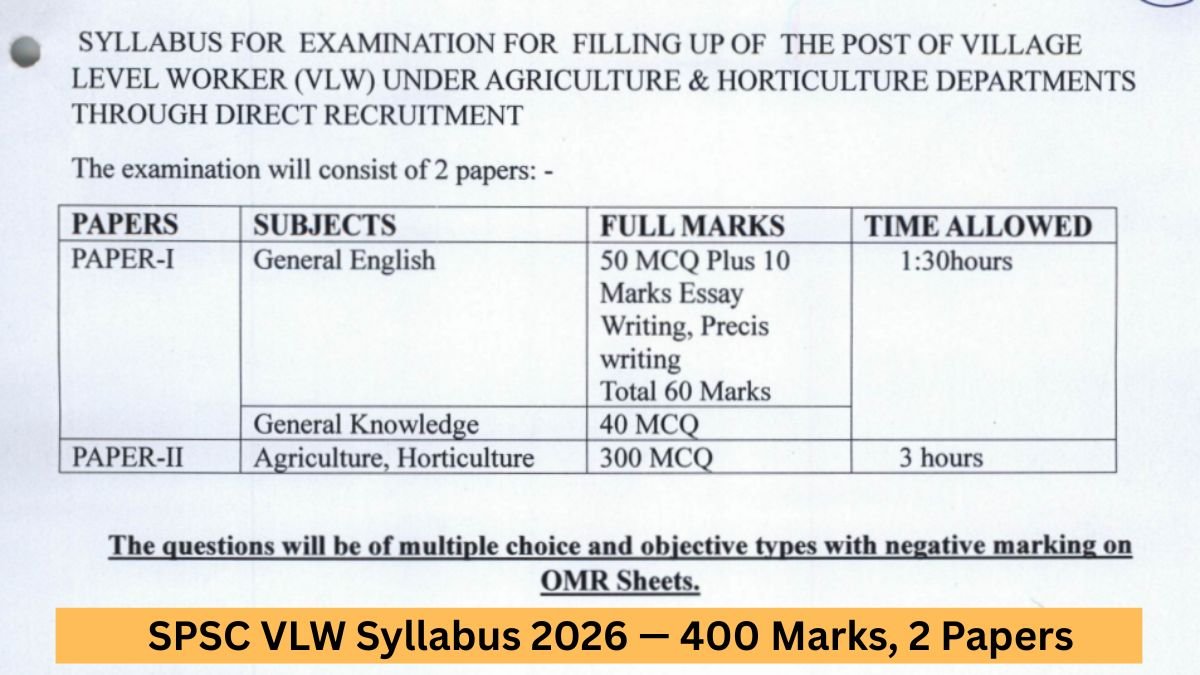
Exam pattern
The written examination has two papers, held with separate time limits. Paper-I covers General English and General Knowledge together; Paper-II covers Agriculture and Horticulture as one combined paper.
| Paper | Subject | Full Marks | Time Allowed |
|---|---|---|---|
| Paper-I | General English (50 MCQ + Essay Writing/Precis Writing worth 10 marks) | 60 | 1 hour 30 minutes (for both subjects in Paper-I) |
| Paper-I | General Knowledge (40 MCQ) | 40 | (included in the 1:30 hours above) |
| Paper-II | Agriculture and Horticulture (300 MCQ) | 300 | 3 hours |
| TOTAL | 400 | 4 hours 30 minutes |
All questions are multiple choice and objective type, answered on OMR sheets, with negative marking. The official syllabus does not say whether Paper-I and Paper-II are held on the same day or on separate days — check the admit card once SPSC releases it.
Syllabus: Paper-I (General English and General Knowledge)
General English: Grammar, composition, comprehension, essay writing, and precis writing.
General Knowledge: General awareness of current affairs, current events of state and national importance, and important historical events of state and national importance.
Syllabus: Paper-II (Agriculture and Horticulture)
The official syllabus does not split the 300 marks between the Agriculture and Horticulture sections separately — both are listed under one paper.
Agriculture:
- Agriculture: definition, introduction, importance and scope.
- Organic farming: definition, components, advantages and disadvantages, certification and scope.
- Classification of crops; effect of weather parameters on crop growth and development.
- Cultivation: types, tillage, tilth and its principles and characteristics; water requirement of crops and methods of irrigation; weeds and their control methods; cropping systems, crop rotation, relay cropping, mixed cropping, multi-storied cropping.
- Soil: types, physical properties and their importance, composition and decomposition; effect of organic matter on soil and soil fertility.
- Nutrients: essential plant nutrients, their function, and deficiency symptoms in plants.
- Extension: definition, objectives, function, principle.
- Plant protection: classification of insect, pest and disease; insects, pests and diseases of cereals, pulses and oilseed crops and their management; Integrated Pest Management and Integrated Disease Management.
- Natural farming: definition, principles, crop management, production of bio inputs; farm machinery/mechanisation.
Horticulture:
- Horticulture: definition, importance, scope and its types.
- Classification of horticultural plants.
- Soil and climatic requirements of horticultural plants; raising and management of nursery.
- Propagation of plants: budding, grafting, layering; training and pruning; planning and layout of orchard; package of practices for cultivation of summer and winter vegetables, fruits and flowers.
- Post-harvest management of vegetables, flowers and fruits: pre-harvest factors, post-harvest factors, maturity index of vegetables and fruits.
- Processing of fruits and vegetables: preparation techniques of jam, jelly, marmalade, pickles, and their methods of judging end point.
- Tools and implements used in a horticulture garden.
- Plant breeding: principles of plant breeding, breeding of field and horticultural crops, commercial plant breeding, genetics, methods of plant breeding; plant biotechnology and tissue culture.
What this syllabus means for preparation
Added context, not part of the official syllabus: Paper-II (Agriculture and Horticulture) carries 300 of the 400 total marks — three-quarters of the exam. General English and General Knowledge together make up the remaining 100 marks. This means subject knowledge from the B.Sc. Agriculture/Horticulture syllabus decides most of the merit list, not English or current affairs. Candidates already holding the degree will find much of Paper-II close to their college coursework, but topics like organic farming, natural farming, and Integrated Pest Management are worth revising specifically, since they are named separately in the syllabus and are easy to under-prepare for.
VLW recruitment in many other states asks for only a Class XII pass and a lighter, general-knowledge-heavy syllabus. Sikkim’s VLW paper is set at degree level, matching its B.Sc.-only eligibility bar, so candidates should prepare it as a subject exam, not a general aptitude test. This is added context, not part of the official syllabus. Confirm exam-day arrangements with SPSC once the admit card is released.
Important dates
| Event | Date |
|---|---|
| Notification and syllabus released | 9 July 2026 |
| Last date for submission of online application | 31 August 2026 |
| Written examination date | Not mentioned in the official syllabus — SPSC will announce this separately |
Important links
| Resource | Link |
|---|---|
| Official SPSC VLW syllabus PDF (Appendix-I) | Full exam pattern and topic-wise syllabus |
| SPSC VLW Recruitment 2026 vacancy article | Vacancy count, eligibility, pay level, apply-online steps |
| Latest Sikkim government job vacancies | More SPSC and Sikkim state recruitment notices |
SPSC Latest Recruitment & Syllabus – Important Sikkim Govt Jobs
- SPSC Warder Recruitment 2026
- SPSC Warder Syllabus 2026
- SPSC Accounts Clerk / Junior Storekeeper Recruitment 2026
- SPSC Accounts Clerk 2026 Syllabus | Paper I & Paper II
- SPSC Sikkim Veterinary Officer Syllabus 2026
FAQs
How many papers are in the SPSC VLW written exam, and what is the total time?
There are two papers. Paper-I (General English and General Knowledge) runs for 1 hour 30 minutes, and Paper-II (Agriculture and Horticulture) runs for 3 hours, for a combined 4 hours 30 minutes.
Is there negative marking in the SPSC VLW exam 2026?
Yes. The official syllabus confirms negative marking on the OMR-based objective questions, but it does not state the exact marks deducted for a wrong answer.
Which subject carries the most marks in this exam?
Agriculture and Horticulture together, in Paper-II, carry 300 of the 400 total marks. General English and General Knowledge, in Paper-I, carry the remaining 100 marks.

ABOUT THE AUTHOR
Jharna Singh runs the regional desk for Sikkim and West Bengal. She covers recruitment, scholarships, college admissions, and apprenticeships — the updates that matter most to readers in our home region. She checks every notification carefully, so the eligibility criteria, deadlines, and application steps are always correct and easy to follow. The State Desk covers SSC and WBPSC job openings, state scholarships, district-level recruitment drives, and apprenticeships under NATS and NAPS — straightforward, reliable updates. Know more