
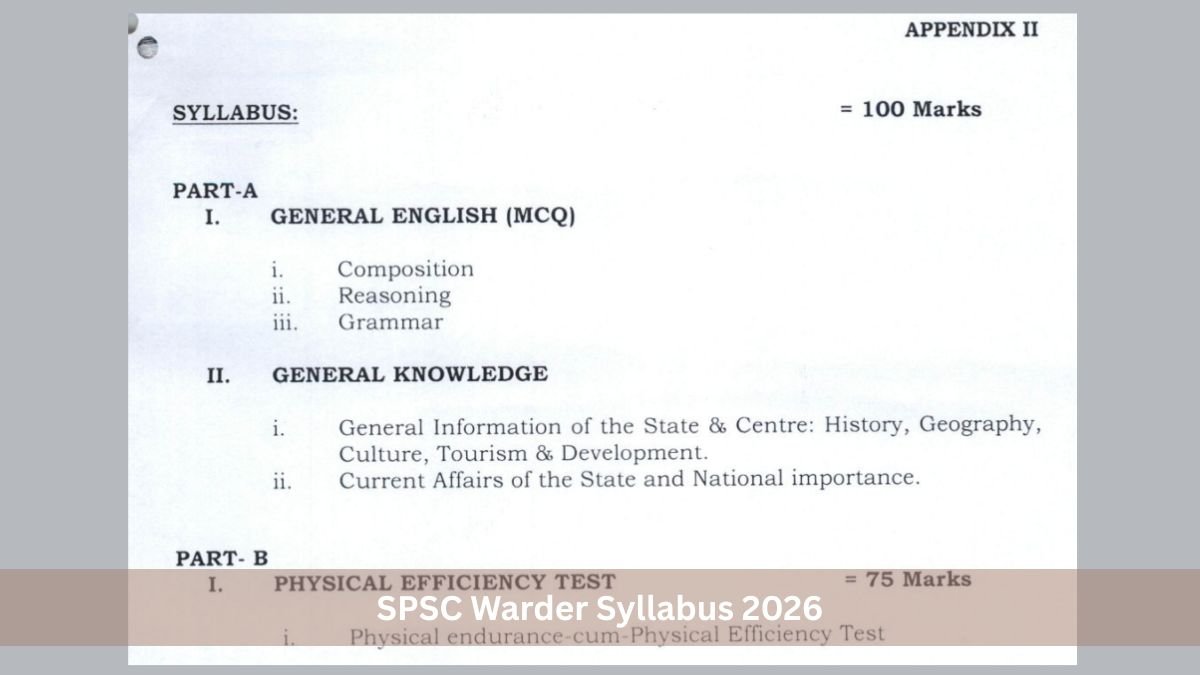
The Sikkim Public Service Commission has released the official Warder syllabus and exam pattern for the 2026 recruitment at the official website https://spsc.sikkim.gov.in. As per the official syllabus, the examination is divided into a written examination under Part-A and a Physical Efficiency Test under Part-B, and carries a total of 175 marks. This guide breaks down the full topic-wise syllabus, the marks for each section, the selection stages, and a preparation approach for the post.
The selection has two parts. Part-A is the written examination carrying 100 marks, and Part-B is the Physical Efficiency Test carrying 75 marks. Each Physical Efficiency Test event sets a minimum standard, and candidates who fall below it are marked failed and disqualified. Candidates should check all details from the below article. Read this article carefully and go through the official syllabus and notification before starting preparation.
Updated on : 27th July 2026 – With reference to Advertisement No. 21/SPSC/EXAM/2026 dated 15/06/2026 and Advertisement No. 22/SPSC/EXAM/2026 dated 17/06/2026, inviting online applications for 50 posts of Accounts Clerk and 37 posts of Jail Warder — due to unforeseen technical issues on the online application portal, the last date for submission of online applications is extended up to 7th August, 2026 (12:00 Midnight). All other terms and conditions of the aforesaid advertisements remain unchanged. Candidates who have already submitted their applications successfully need not apply again.
Information verified from the official Sikkim Public Service Commission syllabus published at https://spsc.sikkim.gov.in/Advertisements/Warder_Syllabus_17_06_2026.pdf.
दार्जिलिङ, सिक्किम, सिलिगुडी र उत्तर बङ्गाल क्षेत्रका स्थानीय जागिर अपडेटहरू नछुटाउनुहोस्। हाम्रो WhatsApp च्यानल, YouTube च्यानल र Facebook पेजमा जोडिनुहोस् र नयाँ रिक्त पदका सूचनाहरू पोस्ट हुनासाथै प्राप्त गर्नुहोस्।
Quick Summary of Warder Syllabus & Exam Pattern
| Category | Details |
|---|---|
| Conducting Body | Sikkim Public Service Commission (syllabus issued under the Home Department, Government of Sikkim) |
| Name of the Post | Warder |
| Exam Stages | Part-A (Written Examination) and Part-B (Physical Efficiency Test) |
| Total Marks | 175 marks |
| Written Exam Marks | 100 marks |
| Physical Test Marks | 75 marks |
| Mode of Exam | General English is stated as MCQ; mode for the rest is not mentioned in the official syllabus |
| Qualifying Stage(s) | Each Physical Efficiency Test event carries a failed and disqualified threshold; written qualifying marks are not mentioned in the official syllabus |
| Official Source | https://spsc.sikkim.gov.in/Advertisements/Warder_Syllabus_17_06_2026.pdf |
Also Read | SPSC Accounts Clerk / Junior Storekeeper Recruitment 2026
About the Warder Exam
The Warder post is a uniformed prison-service role recruited in Sikkim, and the recruitment is conducted by the Sikkim Public Service Commission. The assessment is built in two parts. Part-A is a written examination of 100 marks covering General English and General Knowledge, and Part-B is a Physical Efficiency Test of 75 marks built on five events. Together they form a 175-mark assessment. The written part tests language and awareness, while the physical test measures speed, endurance, and strength against fixed standards. Candidates can also read the related Sikkim Warder Recruitment Notification for vacancy and application details.
Warder Exam Pattern and Marks Distribution
The exam is split into a written part and a physical part. Part-A holds the written marks, and Part-B holds the physical marks. The table below lays out each part with its marks as stated in the official syllabus.
| Part / Stage | Component | Marks |
|---|---|---|
| Part-A | Written Examination (General English + General Knowledge) | 100 marks |
| Part-B | Physical Efficiency Test | 75 marks |
| Total | Combined assessment | 175 marks |
The written examination carries 100 marks and the Physical Efficiency Test carries 75 marks, so the written part holds the larger share of the total. General English is listed as MCQ in the syllabus. The split of the 100 written marks between General English and General Knowledge is not mentioned in the official syllabus. The number of questions, the exam duration, the language of the paper, and any negative marking are also not mentioned in the official syllabus. In the Physical Efficiency Test, each event sets a lowest standard below which a candidate is failed and disqualified, which makes clearing every event a condition for staying in the process.
Exam Context — Sikkim Public Service Commission and the State GK Focus
The Sikkim Public Service Commission conducts this recruitment, and the syllabus shapes the General Knowledge section around both the state and the centre. The official document names History, Geography, Culture, Tourism, and Development of the State and Centre, along with Current Affairs of the State and National importance. This points candidates toward Sikkim-specific awareness: the state’s history and its merger timeline, its mountainous geography and districts, its festivals and communities, tourism circuits, and state development schemes. National-level current affairs sit alongside this state focus, so candidates are expected to follow both Sikkim news and national headlines. This is editorial preparation context, not part of the official syllabus — confirm specifics with the official notification. Based on similar state-level warder and constabulary exam patterns, regional current affairs and state geography tend to carry steady weight in the General Knowledge section, which is why the syllabus names them directly.
Detailed Warder Syllabus — Subject Wise
The detailed syllabus for the Warder post is given below, subject by subject, exactly as listed in the official document. Candidates should cover every topic mentioned.
Part-A: General English (MCQ)
- Composition
- Reasoning
- Grammar
General English is set as multiple-choice questions. This is editorial preparation context, not part of the official syllabus: Composition usually covers sentence formation, comprehension passages, and correct word usage; Reasoning usually covers verbal and non-verbal logic, series, analogies, and coding-decoding; and Grammar usually covers tenses, articles, prepositions, subject-verb agreement, and error correction. The official syllabus lists only the three topic headings above.
Also Read | SPSC Accounts Clerk 2026 Syllabus | Paper I & Paper II
Part-A: General Knowledge
- General Information of the State and Centre: History, Geography, Culture, Tourism, and Development
- Current Affairs of the State and National importance
The General Knowledge section ties directly to Sikkim and the centre. This is editorial preparation context, not part of the official syllabus: the State and Centre information area usually covers state formation and history, physical and administrative geography, cultural communities and festivals, tourism sites, and development and welfare schemes, while the current-affairs area usually covers recent state and national events, appointments, schemes, sports, and awards. The official syllabus lists only the two areas named above.
Physical Efficiency Test (PET) Standards
The Physical Efficiency Test measures speed, endurance, and strength across five events. Each event is graded into three levels (A, B, or C) carrying 15 marks, 12 marks, and 9 marks. A performance below the Level C standard in any event is marked failed and disqualified. The five events together carry 75 marks. The standards below are stated in Regulation no. 47.13 of the Police Manual and are reproduced exactly as in the official syllabus.
100-Meter Race
| For Male Candidates | For Female Candidates | Level | Marks |
|---|---|---|---|
| Below 13 seconds | Below 16.5 seconds | A | 15 marks |
| 13 to 14 seconds | 16.5 to 17.5 seconds | B | 12 marks |
| 14 to 15 seconds | 17.5 to 18.5 seconds | C | 9 marks |
| Above 15 seconds | Above 18.5 seconds | — | Failed and disqualified |
The time taken from start to finish is noted by means of a stop watch and recorded. Candidates will have only one chance at the event. Male candidates above 15 seconds and female candidates above 18.5 seconds are failed and disqualified.
1500-Meter Race
| For Male Candidates | For Female Candidates | Level | Marks |
|---|---|---|---|
| Below 5.5 minutes | Below 6.0 minutes | A | 15 marks |
| 5.5 to 6.5 minutes | 6.0 to 7.5 minutes | B | 12 marks |
| 6.5 to 7.5 minutes | 7.5 to 9.0 minutes | C | 9 marks |
| Above 7.5 minutes | Above 9.0 minutes | — | Failed and disqualified |
The time taken from start to finish is noted by means of a stop watch and recorded. Candidates will have only one chance at the event. Male candidates above 7.5 minutes and female candidates above 9.0 minutes are failed and disqualified.
High Jump
This event allows a maximum of three chances at the qualifying level and one chance at each subsequent level.
| For Male Candidates | For Female Candidates | Level | Marks |
|---|---|---|---|
| Above 1.45 meters | Above 1.20 meters | A | 15 marks |
| 1.30 to 1.45 meters | 1.05 to 1.20 meters | B | 12 marks |
| 1.15 to 1.30 meters | 0.90 to 1.05 meters | C | 9 marks |
| Below 1.15 meters | Below 0.90 meters | — | Failed and disqualified |
The cross bar is placed at the minimum height. Those who qualify in three or fewer attempts are allowed one attempt at the next level. Those who qualify that level are allowed one attempt at the last level. Candidates are placed in level A, B, or C as per their best jump and given marks accordingly. Male candidates below 1.15 meters and female candidates below 0.90 meters are failed and disqualified.
Long Jump
This event allows three chances.
| For Male Candidates | For Female Candidates | Level | Marks |
|---|---|---|---|
| Above 4.55 meters | Above 3.45 meters | A | 15 marks |
| 4.10 to 4.55 meters | 3.05 to 3.45 meters | B | 12 marks |
| 3.65 to 4.10 meters | 2.65 to 3.05 meters | C | 9 marks |
| Below 3.65 meters | Below 2.65 meters | — | Failed and disqualified |
Three lines are marked at the three distances indicated, measured from the front edge of the take-off point. Each candidate has three jumps and is placed in level A, B, or C as per the best jump. If a candidate touches the ground beyond the front edge of the take-off point while jumping, it is treated as a foul. Whether fair or foul, only three jumps are allowed. Male candidates below 3.65 meters and female candidates below 2.65 meters are failed and disqualified.
Shot-Put
This event allows three chances.
| For Male Candidates | For Female Candidates | Level | Marks |
|---|---|---|---|
| Above 7.10 meters | Above 5.10 meters | A | 15 marks |
| 6.10 to 7.10 meters | 4.60 to 5.10 meters | B | 12 marks |
| 5.10 to 6.10 meters | 4.10 to 4.60 meters | C | 9 marks |
| Below 5.10 meters | Below 4.10 meters | — | Failed and disqualified |
A circle of 7 ft in diameter is drawn. Two lines at 30° and 60° are drawn to form the sector in which the shot is to be thrown. Three arcs are then drawn in this sector at the distances stated above from the front edge of the circle. Each candidate has three chances with a 16lb weight for men and a 12lb weight for women, and the best performance level A, B, or C is recorded and marks awarded. Male candidates below 5.10 meters and female candidates below 4.10 meters are failed and disqualified.
Marks Distribution and How to Qualify
The total assessment is 175 marks: 100 marks for the written examination in Part-A and 75 marks for the Physical Efficiency Test in Part-B. The written examination holds the single largest share of marks, while the 75 physical marks are spread evenly across five events, each worth up to 15 marks at Level A. The qualifying condition sits inside the Physical Efficiency Test, where falling below the Level C standard in any event leads to failed and disqualified. Written qualifying marks are not mentioned in the official syllabus. This is editorial preparation context, not part of the official syllabus: because the written examination carries more marks than any single physical event, it is the section that decides the largest part of the total, so candidates aiming for a high score gain most by securing the written marks while clearing every physical event at Level A or B.
Preparation Strategy
The following is editorial preparation guidance, not part of the official syllabus.
The written examination carries 100 of the 175 marks, so it deserves the larger share of study time. Within the written part, candidates can build General English steadily through daily practice of composition, reasoning sets, and grammar rules, since these reward repeated drilling rather than last-minute reading. For General Knowledge, the syllabus points at Sikkim’s history, geography, culture, tourism, and development, so candidates can pair a basic Sikkim general-knowledge resource with daily state and national current affairs over several months. The Physical Efficiency Test rewards consistent, early training rather than short bursts, because each of the five events has a fixed Level C cut-off that disqualifies anyone below it. A common mistake with this kind of pattern is treating the physical test as a formality and training only for the races while neglecting the high jump, long jump, and shot-put, where technique and strength take weeks to build. Based on similar state-level warder and constabulary patterns, candidates who train across all five events early tend to clear the qualifying thresholds with margin and reach the higher A and B levels for more marks.
Best Books and Resources
This is editorial preparation context, not part of the official syllabus — confirm specifics with the official notification. The table below suggests categories of standard resources per subject rather than fixed titles, so candidates can pick a current and reputable edition.
| Subject | Suggested Resource Type |
|---|---|
| General English (Composition, Reasoning, Grammar) | A standard objective general English guide plus a separate reasoning practice book |
| General Knowledge (State and Centre) | A basic Sikkim general-knowledge handbook and a general Indian GK reference |
| Current Affairs | A monthly current-affairs magazine or a daily current-affairs compilation |
| Physical Efficiency Test | A general athletics or fitness training guide covering sprinting, distance running, and field events |
Important Links
Candidates preparing for the Warder post are advised to visit the important links below for the official syllabus PDF and the related recruitment notification:
| Resource | Link |
|---|---|
| Official Syllabus PDF | Warder Syllabus 2026 (SPSC) |
| Warder Recruitment Notification | SPSC Warder Recruitment Notification |
| Latest Sikkim Jobs | Latest Sikkim Government Jobs |
FAQs — Warder Syllabus & Exam Pattern 2026
What is the total marks for the Sikkim Warder exam?
The exam carries 175 marks in total. Part-A, the written examination, carries 100 marks, and Part-B, the Physical Efficiency Test, carries 75 marks, as stated in the official Sikkim Public Service Commission syllabus.
Which section should a Warder candidate focus on first based on the marks?
Editorial guidance: the written examination carries 100 marks, more than the 75-mark physical test, so it holds the larger share of the total. Securing written marks while clearing every physical event gives the strongest overall score.
How many events are in the Warder Physical Efficiency Test?
There are five events: the 100-Meter Race, the 1500-Meter Race, High Jump, Long Jump, and Shot-Put. Each is graded Level A, B, or C, worth 15, 12, or 9 marks, summing to 75 marks.
Is there negative marking in the Warder written examination?
Negative marking is not mentioned in the official syllabus. Candidates should confirm this and other paper details, such as duration and language, from the official notification before preparation.

ABOUT THE AUTHOR
I am Sandeep Khati, the founder of India Job Alerts. I hold a B.Tech in Computer Science from JGEC (2010). My career began as a Systems Engineer at TCS, and I have been active in the digital publishing space since 2011, starting with the launch of SearchDarjeeling.com and my work as a web developer and designer at Darjeeling Informatics.
Launched in April 2025, India Job Alerts is my most focused project to date. I am dedicated to publishing verified government and PSU job notifications for candidates in West Bengal, Sikkim, and across India. To guarantee accuracy, I personally cross-check every post against official notifications before publishing. Know more