
If you are looking for a government job in Sikkim, the SPSC Accounts Clerk / Junior Storekeeper Recruitment 2026 is a great opportunity. This exam is conducted by the Sikkim Public Service Commission (SPSC) under the Finance Department, Government of Sikkim. Many students and job seekers find it hard to understand the syllabus from the official document. That is why we have written this article — to explain everything you need to know.
In this article, you will find:
- The complete exam pattern — how many papers, marks, and time
- Full syllabus of Paper I and Paper II — topic by topic
- Simple explanation of every subject so you know what to study
- A 6-week preparation plan to help you get started
- Answers to the most common questions about this exam
- A direct link to the official vacancy notification
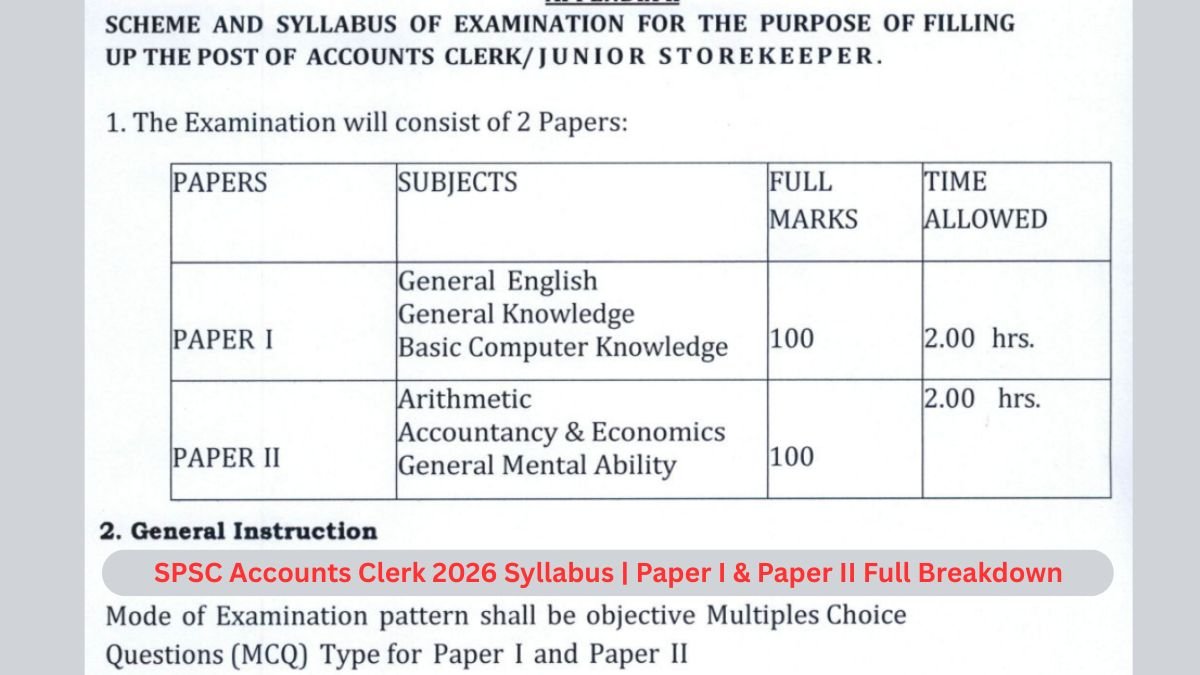
This exam has 2 papers — each worth 100 marks. Paper I covers English, General Knowledge, and Computer Knowledge. Paper II covers Arithmetic, Accountancy, Economics, and Mental Ability. All questions are MCQ (Multiple Choice) type. You do not need to write long answers.
Whether you are a fresh graduate or someone who has been preparing for government exams, this guide will help you understand the syllabus clearly and start your preparation with confidence. Read the full article below — and do not miss the official vacancy notification link at the end for eligibility and application details.
दार्जिलिङ, सिक्किम, सिलिगुडी र उत्तर बङ्गाल क्षेत्रका स्थानीय जागिर अपडेटहरू नछुटाउनुहोस्। हाम्रो WhatsApp च्यानल, YouTube च्यानल र Facebook पेजमा जोडिनुहोस् र नयाँ रिक्त पदका सूचनाहरू पोस्ट हुनासाथै प्राप्त गर्नुहोस्।
Last Updated: June 2026 | Exam: Accounts Clerk / Junior Storekeeper 2026 | Department: Finance Department, Govt. of Sikkim
SPSC Accounts Clerk / Store Keeper Exam Overview
The exam has 2 papers. Both are MCQ (Multiple Choice Questions) type. There are no written or descriptive answers.
| Paper | Subjects Covered | Total Marks | Time Allowed |
|---|---|---|---|
| Paper I | General English + General Knowledge + Basic Computer Knowledge | 100 | 2 hours |
| Paper II | Arithmetic + Accountancy & Economics + General Mental Ability | 100 | 2 hours |
Total Marks: 200 | Total Time: 4 hours (across both papers)
Paper I Syllabus — 100 Marks
1. English Language
This section tests your basic grammar skills and ability to understand written English.
| Topic | What You Need to Know |
|---|---|
| Comprehension | Read a passage and answer questions based on it |
| Vocabulary | Meaning of words; choose the right word in context |
| Synonyms & Antonyms | Words with the same meaning (synonym) or opposite meaning (antonym) |
| Idioms & Phrases | Common English expressions and what they mean (e.g., “burn the midnight oil”) |
| Commonly Confused Words | Pairs like affect/effect, then/than, their/there/they’re |
| Tenses | Correct use of present, past, and future tenses in sentences |
| Sentence Rearrangement | Put jumbled sentences or words into the correct order |
| Error Correction | Find the grammatical mistake in a sentence and correct it |
Study Tip: Practice 10 error correction and rearrangement questions every day. Use any SSC or state PSC English practice book.
2. General Knowledge
This section covers both Sikkim-specific and national general knowledge, plus current affairs.
| Topic | What to Study |
|---|---|
| Sikkim State — General Information | History, geography, districts, administration, important personalities |
| National General Knowledge | India’s constitution, government, major schemes, national symbols |
| Current Affairs | Recent events in Sikkim, India, and the world (last 6–12 months) |
| Abbreviations | Common abbreviations like GDP, RBI, NITI Aayog, UNESCO, ISRO, PM, CM, etc. |
Study Tip: Read a daily newspaper (or a reliable news app) and keep a small notebook for current affairs and abbreviations. Focus especially on Sikkim state news.
3. Basic Computer Knowledge
This section covers computer basics that any office clerk would need to know.
| Topic | What to Study |
|---|---|
| Hardware | CPU, RAM, hard disk, monitor, keyboard, mouse, printers — what each part does |
| Software & Applications | Types of software — system software, application software, operating systems (Windows) |
| Microsoft Office | MS Word (documents), MS Excel (spreadsheets), MS PowerPoint (presentations) — basic features |
| Internet & Intranet | How internet works, browsers, email, difference between internet and intranet |
| E-Payments | UPI, NEFT, RTGS, IMPS, online banking, digital wallets — what they are and how they work |
| Computer Abbreviations | USB, PDF, URL, HTTP, HTTPS, Wi-Fi, LAN, WAN, RAM, ROM, CPU, GB, MB, etc. |
Study Tip: Focus on MS Office shortcuts and e-payment terms. Questions on computers are mostly factual — easy marks if you revise regularly.
Paper II Syllabus — 100 Marks
4. Arithmetic
This is the math section. It covers topics from Class 8–10 level mathematics.
| Topic | What to Study |
|---|---|
| Number System & Number Series | Types of numbers (natural, whole, integers, rational); find the next number in a pattern |
| HCF & LCM | Highest Common Factor and Lowest Common Multiple — how to find them and use them |
| Simplification | Solve complex math expressions using BODMAS rule |
| Word Problems on Numbers | Real-life problems that use addition, subtraction, multiplication, and division |
| Averages | Find the average of a group of numbers; problems on mean |
| Ratio & Proportion | Compare two quantities; direct and inverse proportion |
| Percentage | Calculate percentage of a value; % increase and decrease |
| Profit & Loss | Cost price, selling price, profit %, loss % — find any one when others are given |
| Discount | Marked price, trade discount, cash discount, net price |
| Simple Interest (SI) | Calculate interest using formula: SI = (P × R × T) / 100 |
| Compound Interest (CI) | Calculate CI using formula; difference between SI and CI |
| Partnership | How profit is divided among business partners based on investment and time |
| Unitary Method | Find value of one unit, then use it to find value of many units |
| Work & Wage | Time and work problems; calculate how long a job takes or how much a worker earns |
| Data Interpretation | Read and answer questions from tables, bar charts, pie charts, and line graphs |
Study Tip: Arithmetic carries the most questions. Practice at least 15 problems daily — focus on Percentage, Profit & Loss, SI/CI, and Data Interpretation first.
5. Accountancy & Economics
Accountancy
This part covers basic bookkeeping and accounting concepts used in office work.
| Topic | What to Study |
|---|---|
| Introduction to Accounting | What accounting is, why it is done, who uses it |
| Theory Base of Accounting | Basic accounting concepts and conventions (e.g., going concern, consistency, prudence) |
| Accounting Equation | Assets = Liabilities + Capital — understand and apply this formula |
| Rules of Debit and Credit | The three golden rules: Real, Personal, Nominal accounts |
| Journal | Recording transactions in a journal with date, account names, debit, credit amounts |
| Ledger | Posting journal entries into the ledger; format and purpose of ledger accounts |
| Cash Book | Recording cash and bank transactions; single column and double column cash book |
| Accounting Abbreviations | Dr (Debit), Cr (Credit), P&L (Profit & Loss), B/S (Balance Sheet), A/c (Account), etc. |
Economics
| Topic | What to Study |
|---|---|
| Economic Development | What development means; difference between growth and development; how it is measured (GDP, HDI) |
| Development Sectors | Primary sector (farming, mining), Secondary sector (manufacturing), Tertiary sector (services) |
| Money & Credit | Role of money in the economy; how banks give loans; role of RBI |
| Globalization | How countries trade with each other; advantages and disadvantages of globalization |
| De-monetization | What it means; India’s 2016 demonetization — reasons and impact |
| Government Budget | Meaning of a government budget; revenue budget vs capital budget; surplus, deficit, balanced budget |
Study Tip: For Accountancy, memorize the three golden rules and practice at least 5 journal entries daily. For Economics, focus on definitions and examples — questions are usually straightforward.
6. General Mental Ability
| Type | What to Expect |
|---|---|
| Figural Reasoning | Identify patterns in shapes; mirror images; odd one out; figure completion |
| Numeric Reasoning | Number patterns, missing numbers in a series, analogies using numbers |
Study Tip: Practice 5–10 reasoning questions daily from any competitive exam book. These are quick to improve with regular practice.
Looking for other private and Government Jobs in Sikkim / Gangtok – Check this section – Latest Sikkim Jobs
Quick Preparation Plan
| Week | Focus Area | Daily Target |
|---|---|---|
| Week 1–2 | Arithmetic (all 15 topics) | 15 practice problems per day |
| Week 3 | Accountancy — Journal, Ledger, Cash Book | 5 journal entries + 20 theory MCQs per day |
| Week 4 | English — Grammar, Vocabulary, Comprehension | 1 comprehension passage + 10 grammar MCQs per day |
| Week 5 | GK + Current Affairs + Computers | Read news + revise 20 GK facts + 10 computer abbreviations per day |
| Week 6 | Full revision + Mock tests | 1 full mock paper per day; review mistakes |
Also Read | spsc.sikkim.gov.in Veterinary Officer Recruitment 2026
Top 5 FAQs — Accounts Clerk / Junior Storekeeper Exam 2026
Q1. How many papers are there and what are the total marks?
There are 2 papers — Paper I and Paper II. Each paper carries 100 marks, making the total 200 marks. Each paper is 2 hours long, so the total exam time is 4 hours.
Q2. What type of questions will be asked — MCQ or written?
Both papers will have only MCQ (Multiple Choice Questions). You choose one correct answer from the given options. There are no written or descriptive answers.
Q3. Which subjects should I focus on most for Paper II?
Arithmetic and Accountancy carry the most weight in Paper II. Focus on Profit & Loss, Percentage, Simple and Compound Interest, journal entries, and the golden rules of debit and credit. These topics appear in almost every exam of this type.
Q4. Is there negative marking in this exam?
The official syllabus document does not mention negative marking. However, always check the vacancy notification before the exam to confirm this.
Q5. What is the best way to prepare for General Knowledge?
Read a reliable daily newspaper and focus on Sikkim state news. Also revise basic national facts — India’s constitution, government structure, and major government schemes. Keep a short notes file for abbreviations and monthly current affairs.
SPSC Accounts Clerk / Junior Storekeeper Recruitment 2026 Vacancy Notification
For complete details on eligibility criteria, age limit, educational qualification, application process, and important dates — read the official recruitment notification:
👉 SPSC Accounts Clerk / Junior Storekeeper Recruitment 2026 — Full Notification
Disclaimer: This syllabus guide is prepared based on the official Appendix-II of the Accounts Clerk / Junior Storekeeper Examination issued by the Finance Department, Government of Sikkim. Always refer to the official notification for the most accurate and updated information.

ABOUT THE AUTHOR
I am Sandeep Khati, the founder of India Job Alerts. I hold a B.Tech in Computer Science from JGEC (2010). My career began as a Systems Engineer at TCS, and I have been active in the digital publishing space since 2011, starting with the launch of SearchDarjeeling.com and my work as a web developer and designer at Darjeeling Informatics.
Launched in April 2025, India Job Alerts is my most focused project to date. I am dedicated to publishing verified government and PSU job notifications for candidates in West Bengal, Sikkim, and across India. To guarantee accuracy, I personally cross-check every post against official notifications before publishing. Know more